

Net Zero: 2026 Perspective
For the seventh year, Eden McCallum hosted Lord (Adair) Turner, Chair of the Energy Transitions Commission, to share his perspective on progress towards achieving net zero.
Below is a high level summary of the talk and the full presentation can be found here, as well as a recording of the event here.
Net zero: how are we doing?
“In terms of emissions and temperatures we are doing badly,” Lord Turner said.
On the basis of current policies, the world is heading for average temperatures of between 2.5-2.90C above pre-industrial levels. Extreme weather events are happening with increasing frequency around the world. The cost-benefit is massively in favour of taking action, Lord Turner said. Investing between 1% and 2% of GDP over the next 75 years could limit global warming to 20C or below. Not taking action could cost ten times more.
The good news is technological
Experts’ understanding of the potential for and cost of technological solutions to reduce emissions continues to improve. The good news is that, for around 60% of all emissions, we already have the technology to deliver clean, efficient renewable energy at low or negative cost to consumers. The key here is to electrify as much as possible, as quickly as possible.
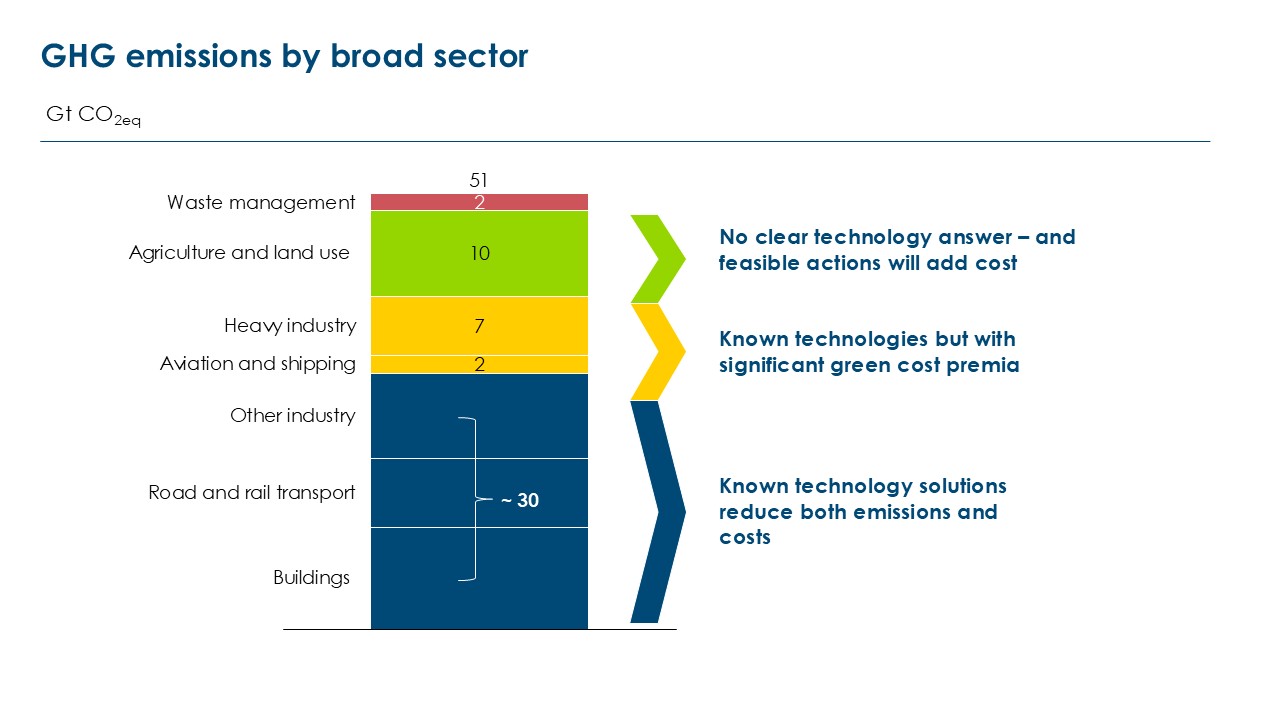
The c.20% that is attributable to heavy industry, aviation and shipping, where electrification is more difficult or impossible, is where it gets more expensive, Lord Turner said. But the technologies to remove these emissions are available, and while they will tend to result in a “green cost premium” at the intermediate product level (e.g., a tonne of iron), the resulting increase in costs of consumer end products (e.g., a car made with green steel) will be very small.
The final c.20% comes from the most difficult sector to mitigate, our food system. Here the focus needs to be on reducing methane emissions from ruminants and avoiding further land use change (i.e., deforestation and crops grown to feed livestock) rather than energy use itself.
The “electro tech stack” is driving down per unit cost and increasing performance
Solar PV, batteries, power electronics, embedded computing, and electric motors/dynamos (EVs): these five inter-connected technologies have seen cost reductions per unit of power of over 95% in the last 30 years alongside leaps forward in performance, Lord Turner said. “Over time, the cost of everything to do with renewables and electrification is going to fall relative to the cost of fossil fuel extraction and combustion. That is unstoppable. We just have to make some investments to get there.”
China has made a huge bet that the future is electric
The second part of Lord Turner’s talk considered geopolitics. China is vital because in solar PV, electric motors, batteries, power electronics, and increasingly in embedded computing, it is China that leads. “China has developed an extraordinary cost and technological advantage in these areas,” Lord Turner said “and they have more research scientists and engineers devoted to this than anybody else in the world.”
“Under President Trump, the US has made a bet in the other direction, to stick to and double down on fossil fuel technology. Even leaving aside the environmental impact, it cannot possibly achieve the energy system cost reductions which the electro tech stack will achieve.”
Challenge for European businesses
On the topic of what Europe can do to defend its industrial competitiveness without giving up on the cost advantage of working with China, Turner suggests that businesses should aim for diversified supply chains, but not complete autarky. They should vary their strategy by sector to reflect different starting points and focus on the location of employment and value added, rather than ownership. Considering different dimensions of “security” is also key.