

Eden McCallum Consumer Survey: Digital Purchasing Behaviour, Q3 2026
What compels consumers to buy online, and how has their use of digital and offline channels evolved since Covid? Eden McCallum’s annual survey of consumer sentiment and spending in the UK and the Netherlands has been exploring digital shopping behaviours across a range of goods and services annually since 2021.
The survey, of around 2000 consumers in each of the UK and the Netherlands, looked separately at the purchasing of groceries, other physical goods categories, and three sets of services: hospitality (holidays and meal delivery), financial services, and utilities.
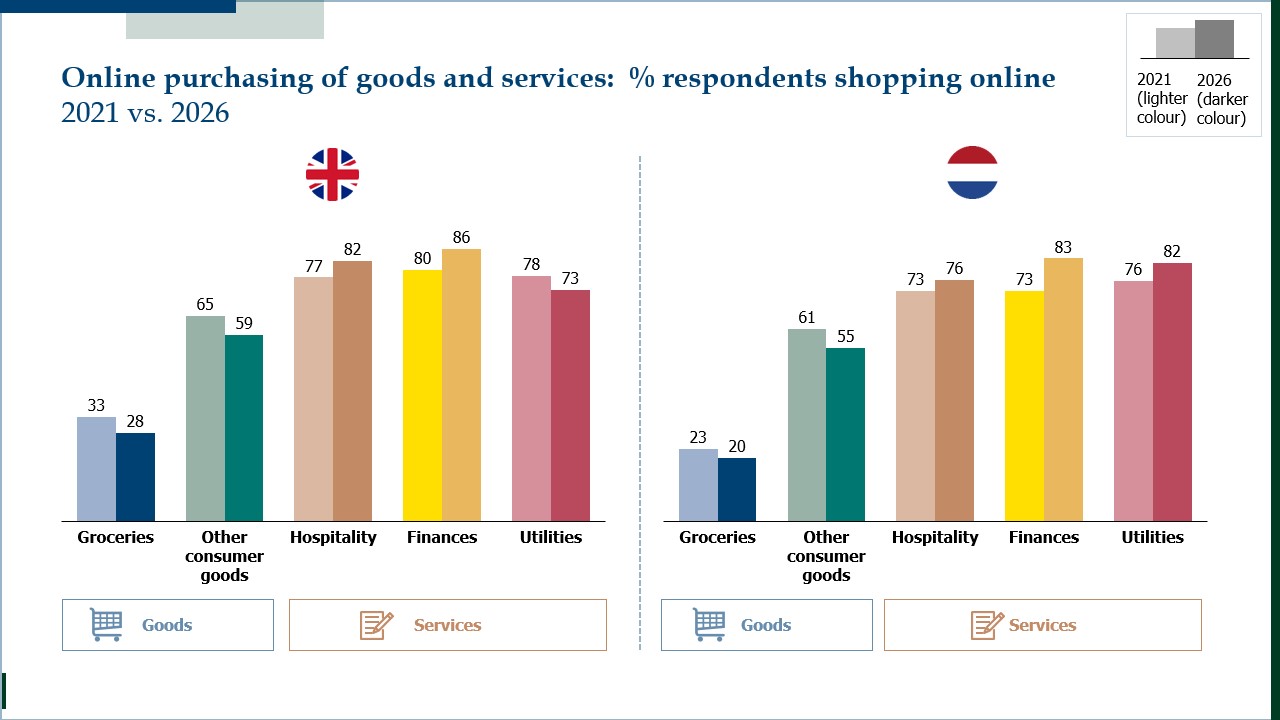
The survey found the majority of consumers buying non-grocery goods and services online. In goods, online shopping is still below 2021’s Covid lockdown peaks, while in services, online shopping is generally higher now, particularly in financial services.
Drawing consumers to buy goods online are chiefly ease of delivery, product choice and better deals. Retailers are chosen because of the ease of shopping with them, the value they offer and their product range. As far as services are concerned, hospitality is purchased online because of the deals and choice on offer and the ability to compare options. Speed and ease of use are key factors when purchasing financial services and utilities. And yet the phone remains the most widely used channel for customer service across categories.
Let us look at different sectors in more detail.
Groceries
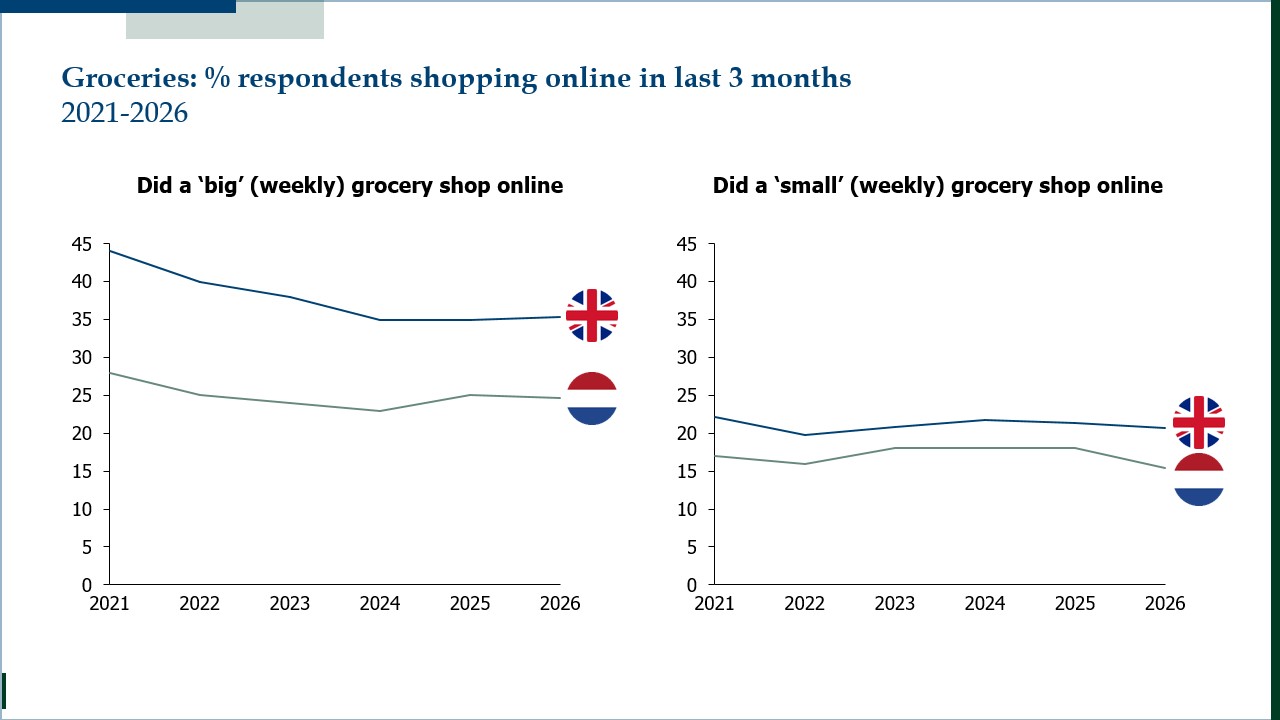
In groceries, we looked at both the big weekly shop and smaller top ups. Around 35% of UK consumers choose to do their big weekly shop online, while the figure is a quarter in the Netherlands. Those figures have been more or less stable for the past few years, following initial post-Covid declines. Fewer consumers do their smaller shops online, with one-fifth of UK shoppers and c. 15-18% of Dutch shoppers doing so, largely stable over the past five years. Ease of home delivery is by far the main reason respondents choose to buy groceries online for both big and small shops.
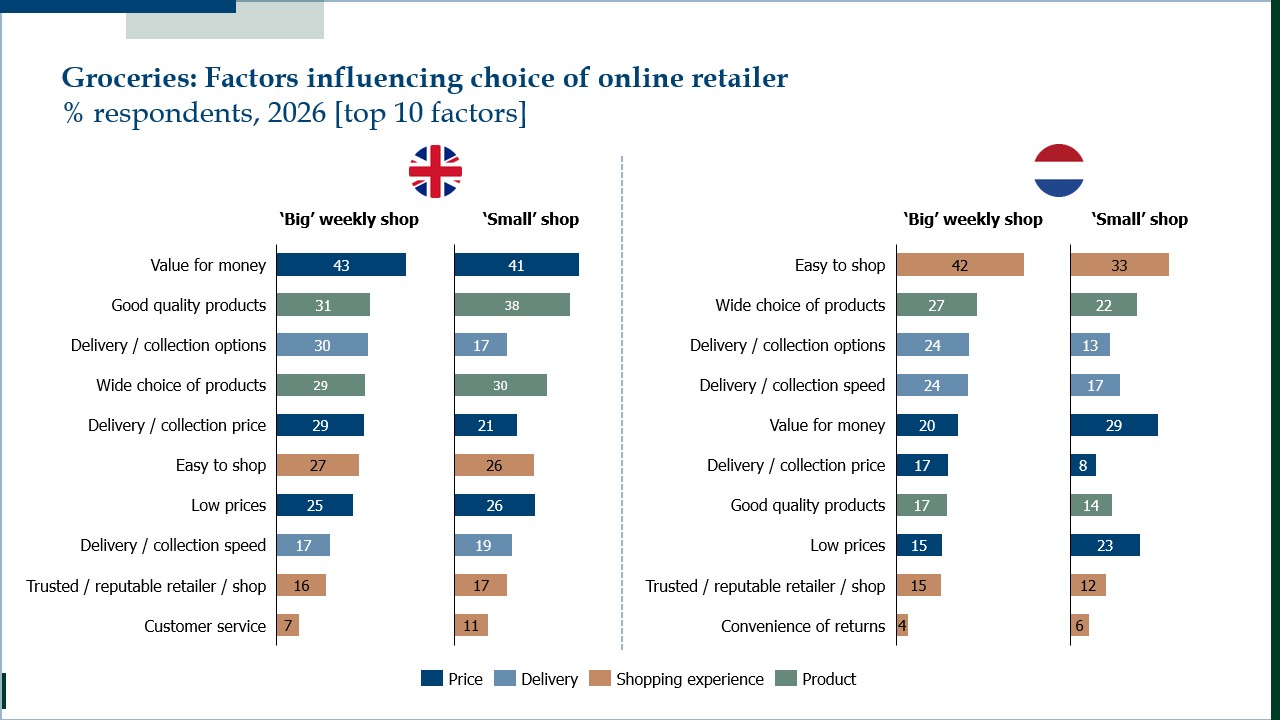
Supermarket websites are the most important retailers for buying groceries online, particularly for big grocery shops. In the UK, value for money (according to 43%) and quality (31%) are the top factors for respondents when choosing their retailer for both big weekly and small grocery shops. In the Netherlands it is the ease of shopping online that is seen as being most important, by 42% of respondents.
Other goods
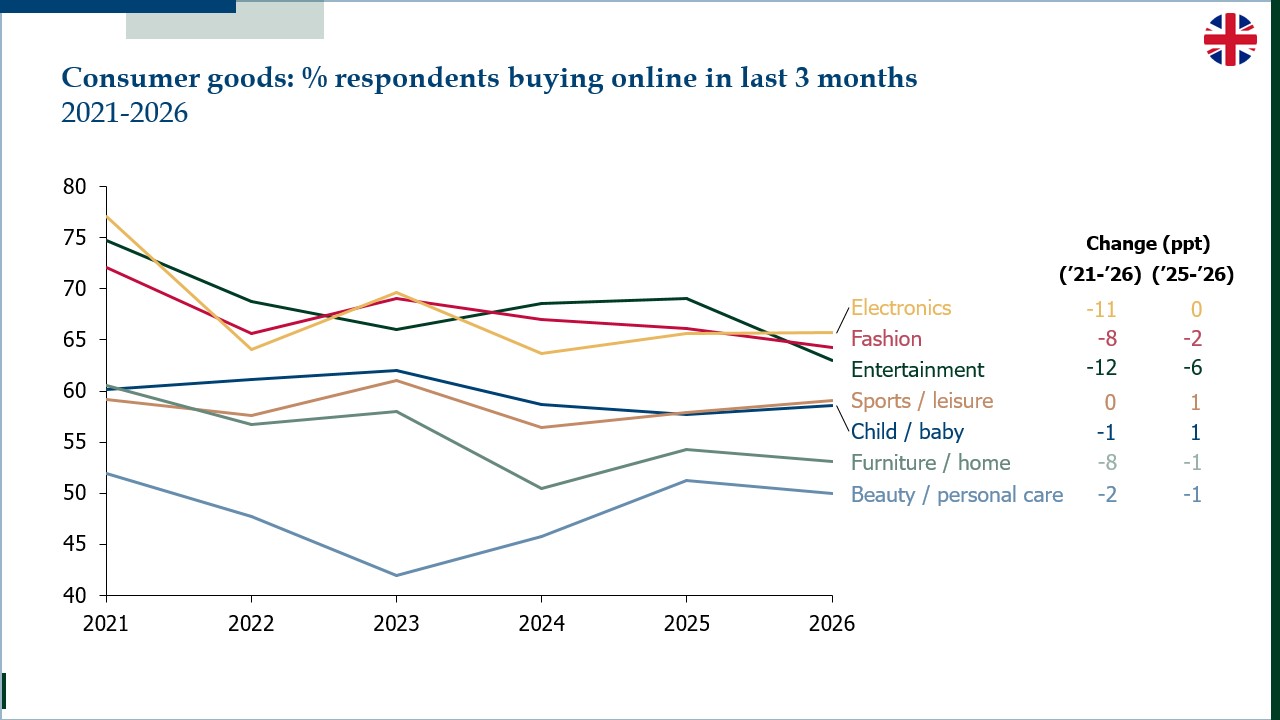
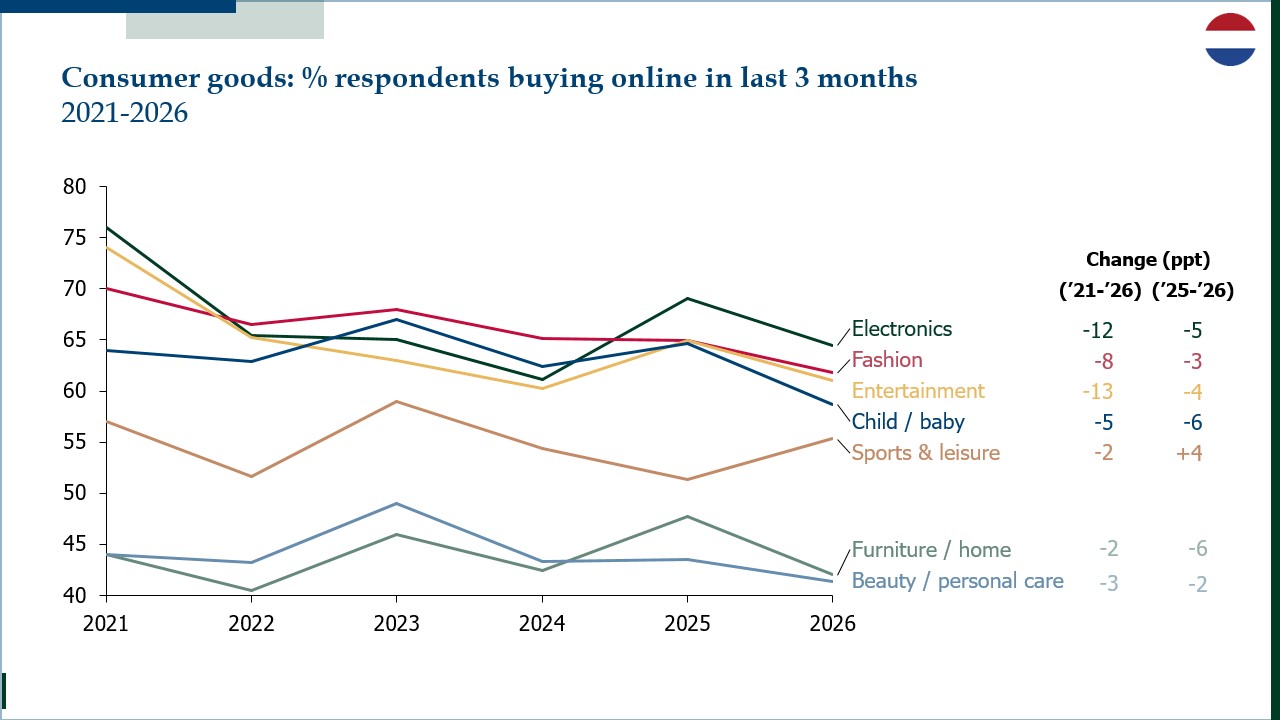
Our physical goods categories surveyed are: electronics, fashion, entertainment (e.g., books, games), furniture / homewares, sports / leisure equipment, beauty / personal care and child / baby (clothes, toys). Of respondents who purchased physical goods in the last three months, at least half did so online across all categories in the UK and most in the Netherlands (except beauty/personal care at 42% and furniture/home purchases at 41%). The biggest online categories were electronics, fashion and entertainment, purchased online by over 60% in both countries.
In both markets, most online purchases are below 2021 levels, a time when pandemic lockdowns had encouraged the growth of online shopping. The biggest declines since 2021 have been in entertainment, electronics, fashion and furniture / home.
In the UK, other categories (sports, children, beauty) are roughly at 2021 Covid levels of online shopping, having largely maintained their Covid online penetration over the past five years. The exception to that pattern is online beauty, which declined sharply to 2023 (c. 10ppts) and then recovered. All categories (except entertainment) have been relatively stable over the past year.
In the Netherlands, online shopping in these other categories is somewhat lower than the 2021 peak, with the past year seeing declines in online shopping in most categories except sports / leisure.
In the UK, ease of home delivery is the main reason respondents choose to shop online for these non-food physical goods (cited by 43%), followed by cheaper prices or better deals (38%) and more choice (32%). In the Netherlands that order is reversed: better deals are the main attraction, according to 39% of respondents, followed by product choice (35%) and easier home delivery (33%). The details for each sub-category can be found in the full report (link at the bottom of this article), and there are some variations to the overall trends (e.g., in the UK, cheaper prices is the top factor in entertainment, and in the Netherlands, choice is the top factor for sports / leisure).
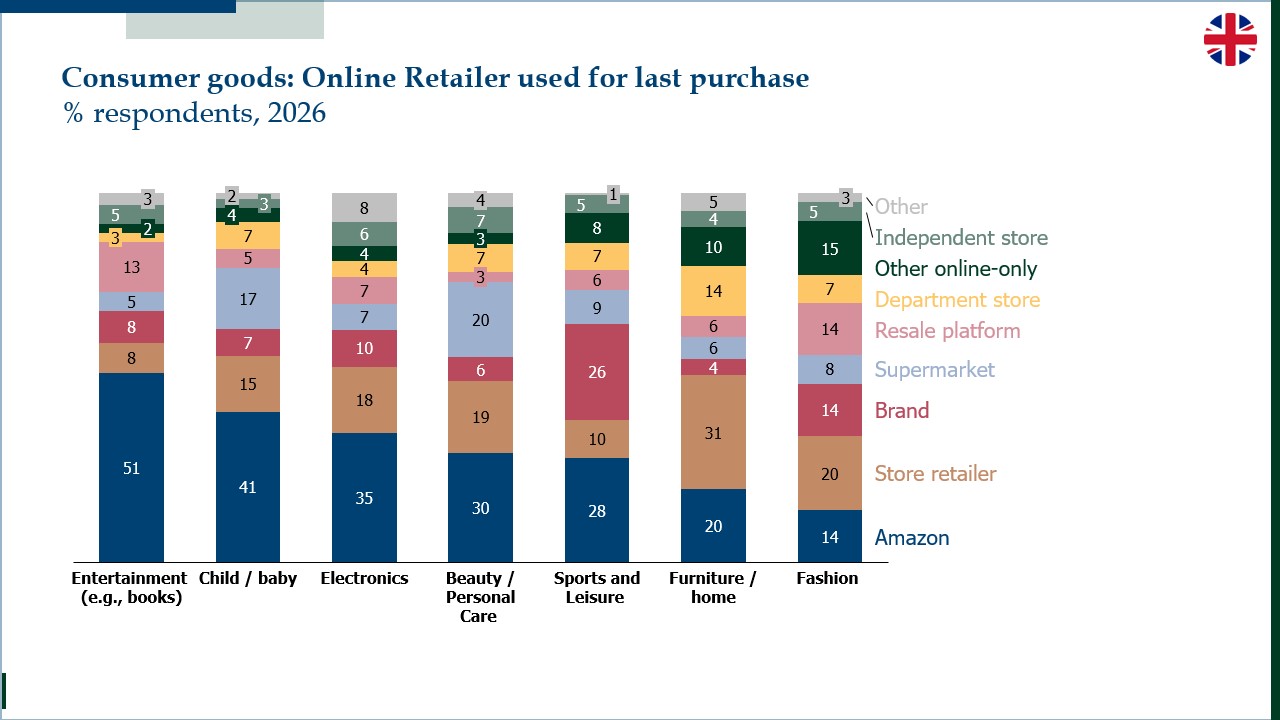
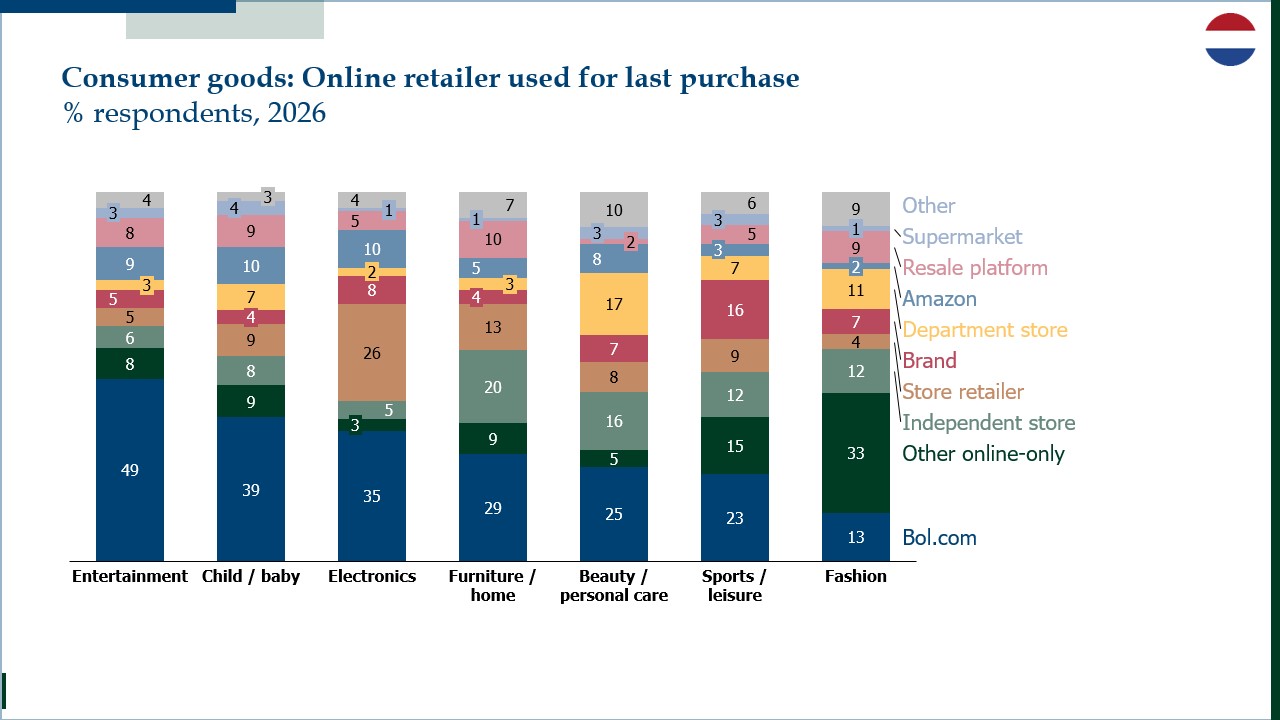
The online ‘everything stores’ dominate non-food online purchasing in most categories in both countries. In the UK, Amazon is by far the leading retailer for purchasing most of the surveyed categories online, except furniture / home and fashion, where physical retailers’ websites have the biggest share. In the Netherlands, Bol.com leads in the purchasing of physical goods across all non-food categories, except fashion, where other online pureplay retailers dominate. Re-sale platforms are becoming a significant channel, accounting for 10% or more of purchases in fashion and entertainment in the UK, and in furniture / home in NL.
For British shoppers, value for money and good quality products are by far the most important factors when choosing an online retailer (44% say so). Low prices are the next most important, cited by 27%. In the Netherlands value for money is the leading consideration, reported by 39%. Choice of products (34%) and low prices (30%) come next.
In the UK, delivery to the home or office is the most popular delivery option across consumer goods, although click and collect is used for over 10% of purchases on average. In the Netherlands collection lockers are just as popular as click and collect, with each option being used by 10% of shoppers.
Hospitality
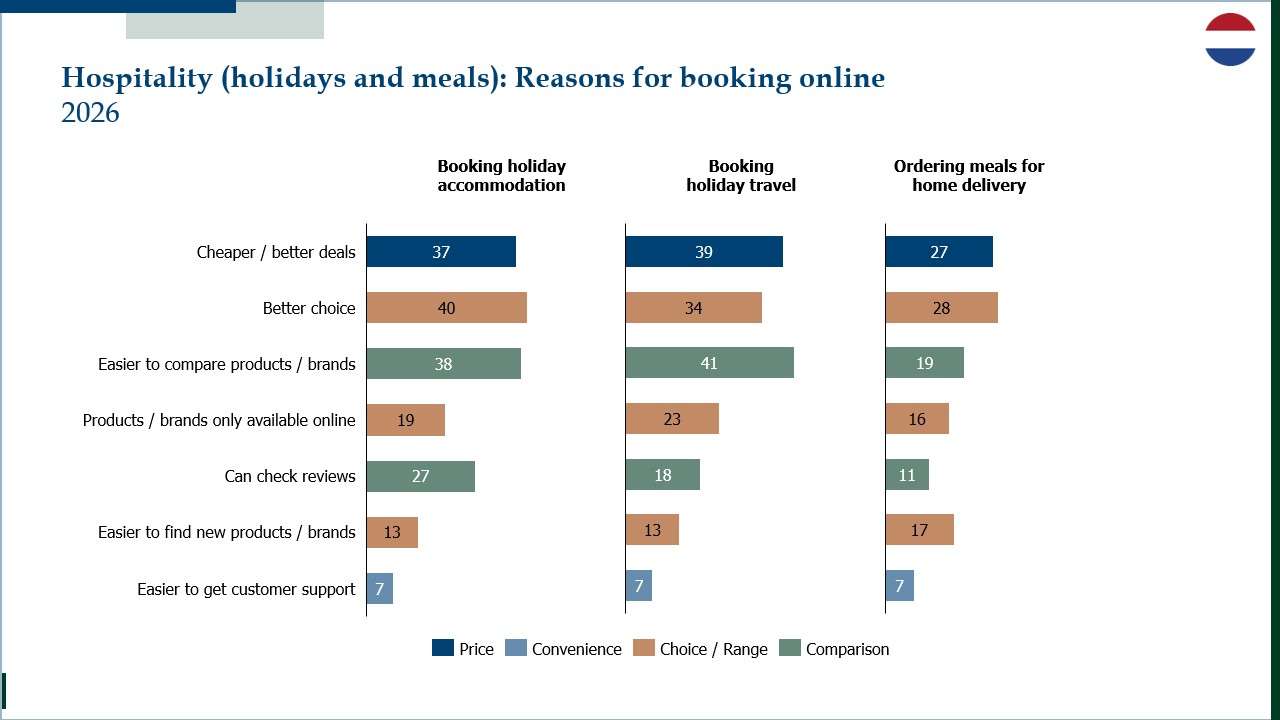
In hospitality, we asked consumers about their purchases for holiday travel (e.g., flights, trains) and accommodation, as well as meals for home delivery. In the UK, online channels are used by 80% or more of consumers for all three of these categories while in the Netherlands it’s c 75%.
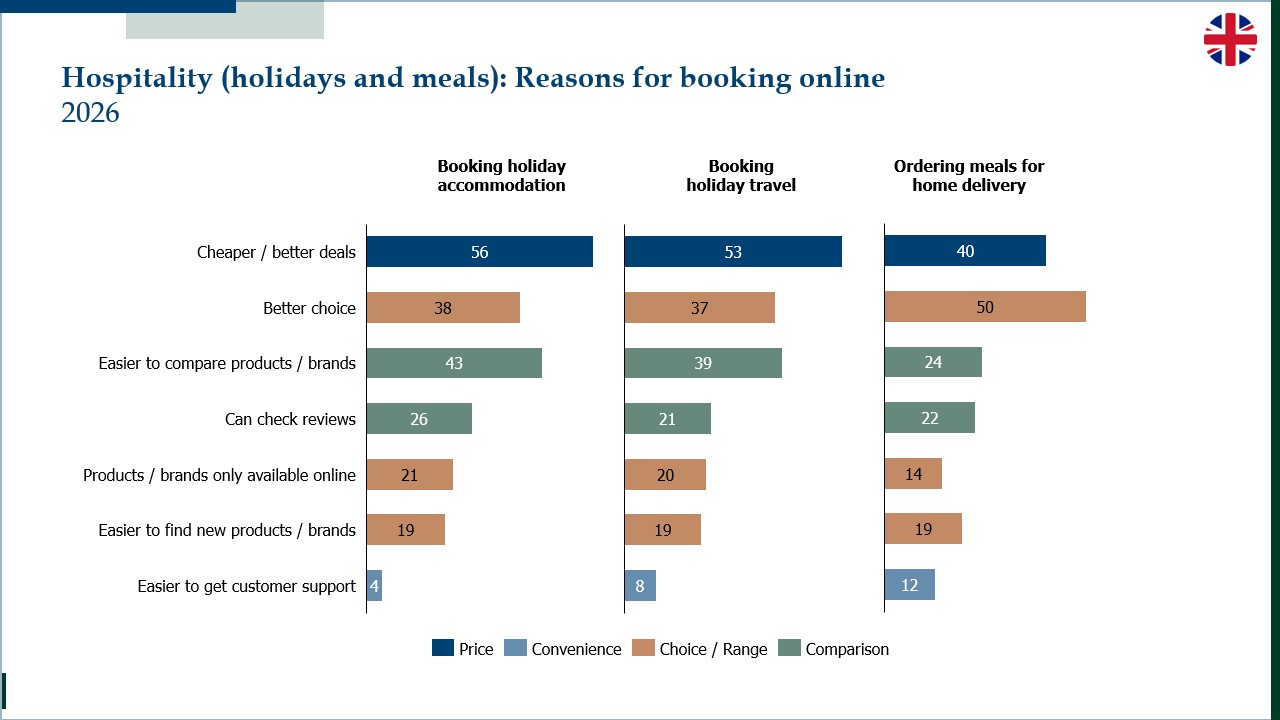
Since 2021 the use of online channels for hospitality services has increased in the UK by c. 5ppts in each category, though growth in online use has slowed in the last year. In the Netherlands, online usage is largely flat post-pandemic. In both markets cheaper deals, better choice and easier comparison are the top three reasons for booking online across hospitality as whole, with UK travellers more widely attracted by deals than those in the Netherlands.
Financial Services
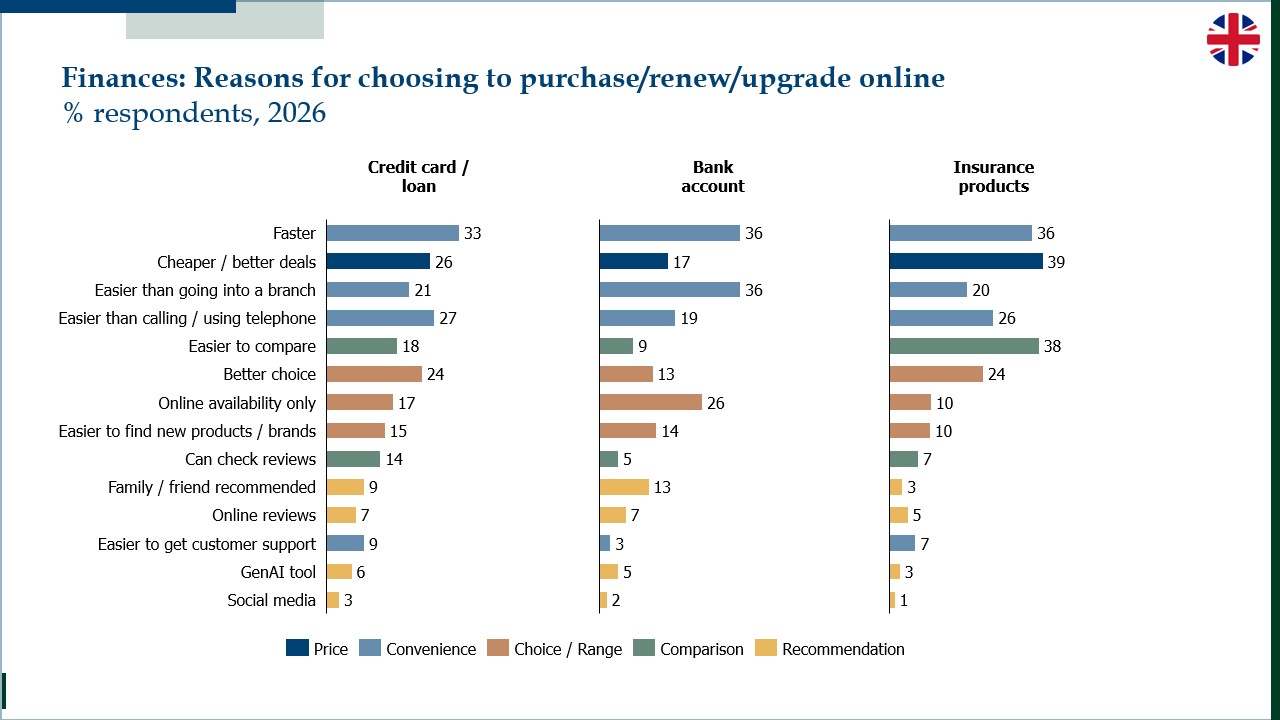
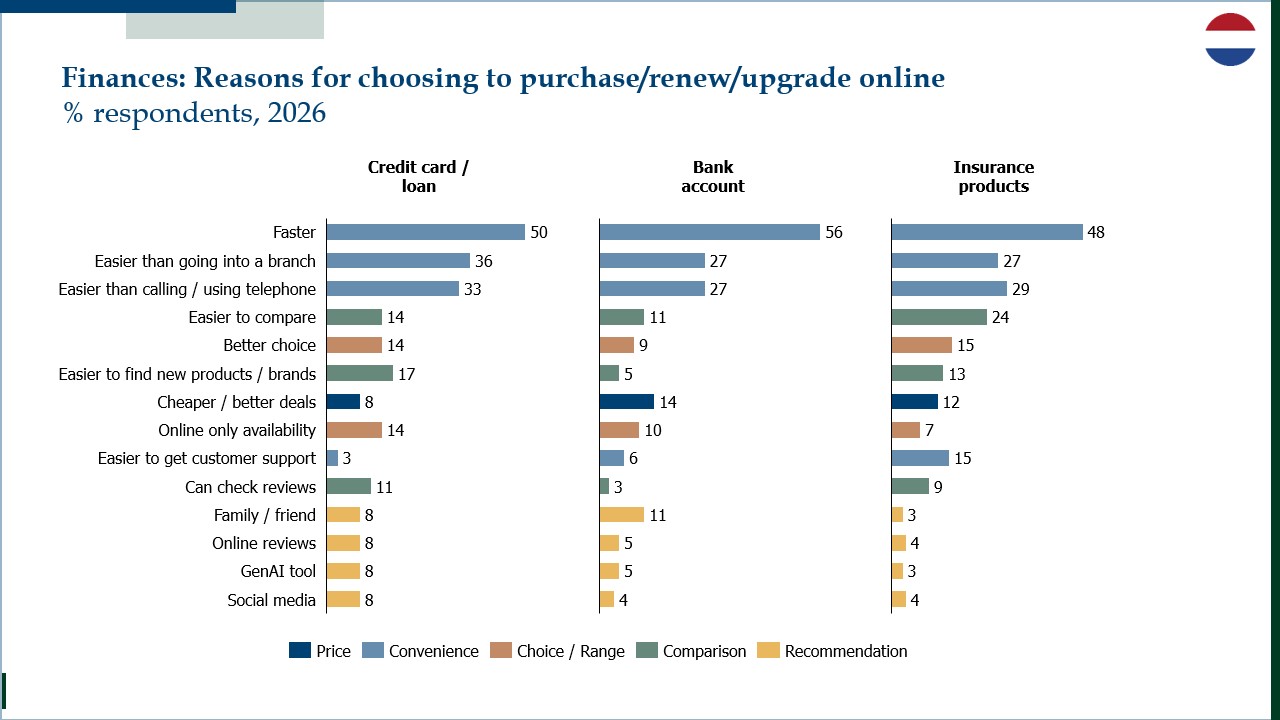
In both the UK and Netherlands, online channels were used by over 80% of respondents applying for credit cards, loans, and bank accounts. Since 2021, use of online channels for financial services has increased. Convenience-related factors (speed, ease), better deals, and ease of comparison are the main reasons respondents choose to handle finances online, with speed an even stronger driver in the Netherlands (cited by an average of 51%) than in the UK (cited by around a third) and the UK relatively more attracted by better deals.
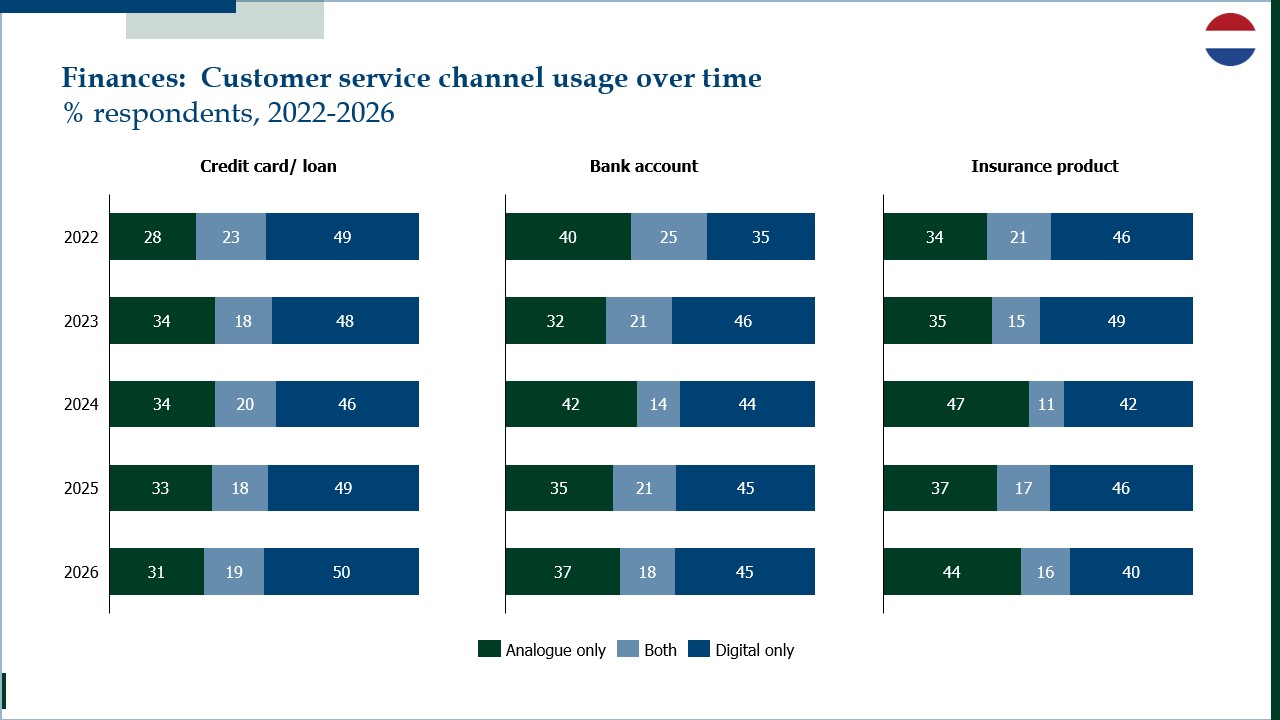
For customer service, the use of analogue channels (e.g., phone, branches) remains stubbornly high for all or part of the customer service journey.
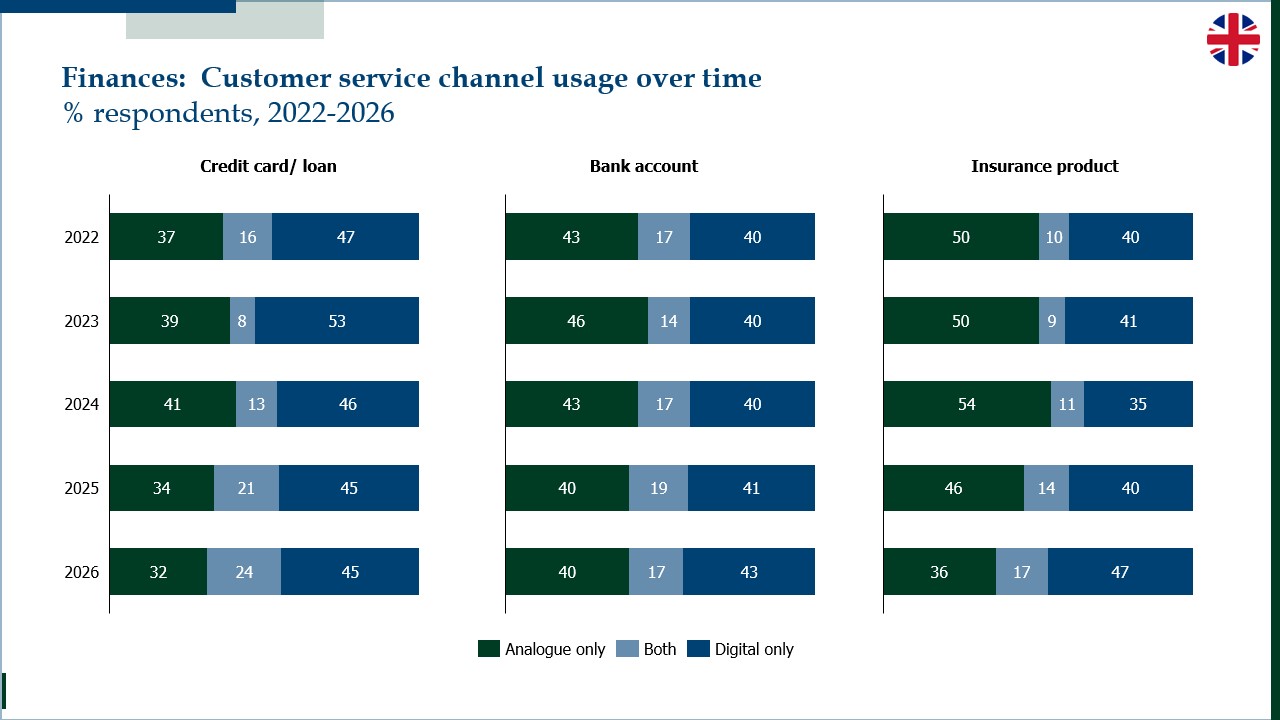
In both countries the telephone is still the most used customer service channel for finances, particularly for queries relating to respondents’ bank accounts and insurance.
In the UK analogue-only usage has been reducing somewhat, mostly replaced by a mix of digital and analogue. Digital-only represents less than half of journeys, and this has been fairly stable over time other than in insurance, where it has grown from 40% in 2021 to 47%.
In the Netherlands, digital-only channel usage for customer service has been hovering at under 50% of interactions across the financial services categories, though in insurance it dipped this year to 40%, below Covid levels (46%), in a reverse of the UK’s pattern.
Utilities
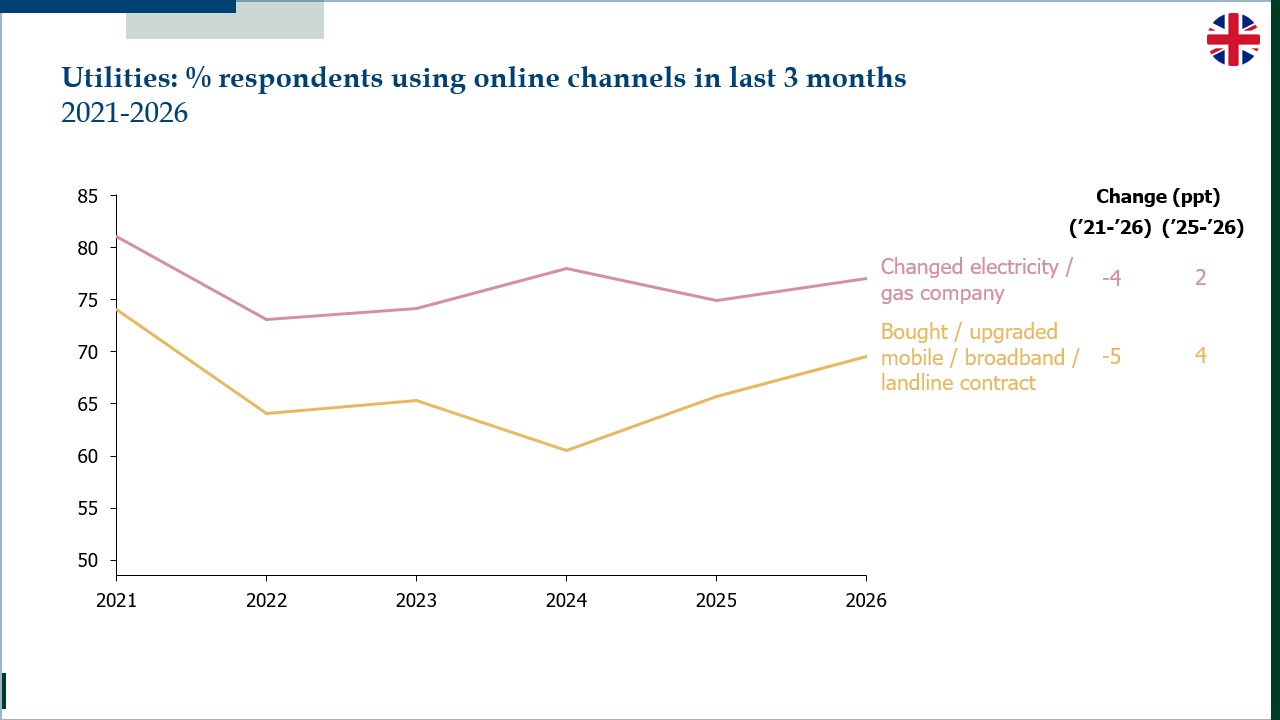
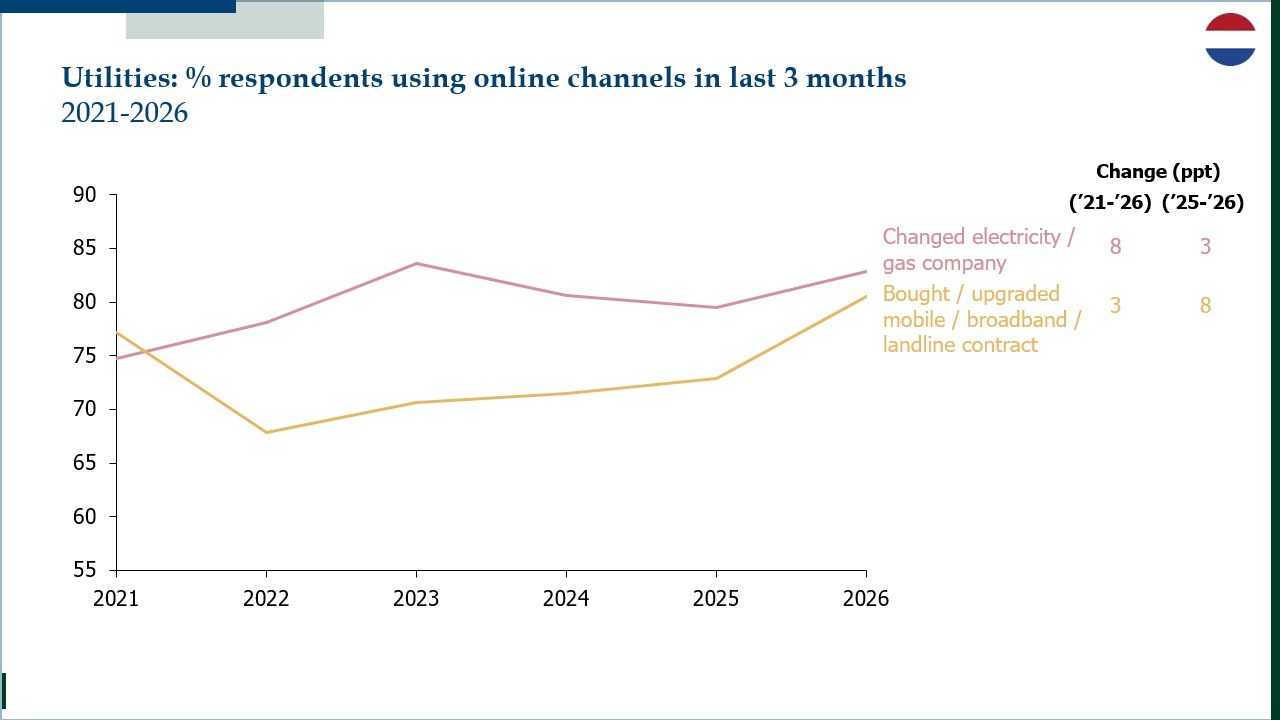
In the UK, just over two-thirds of telecom and three-quarters of energy contract purchases were made online. In the Netherlands there is even greater use of online channels: over 80% of respondents signing up for new utilities contracts did so online; this is the only category of purchases where Dutch online penetration is higher than the UK.
In the UK, use of online channels for utilities purchases is up from last year though not yet back to 2021 levels. In the Netherlands over the same period the use of online channels for purchasing utilities has fluctuated, but is higher for both telecoms and energy than in 2021.
In both countries respondents choose to handle their utilities online so they can compare the services, find better deals and purchase faster than using traditional channels.
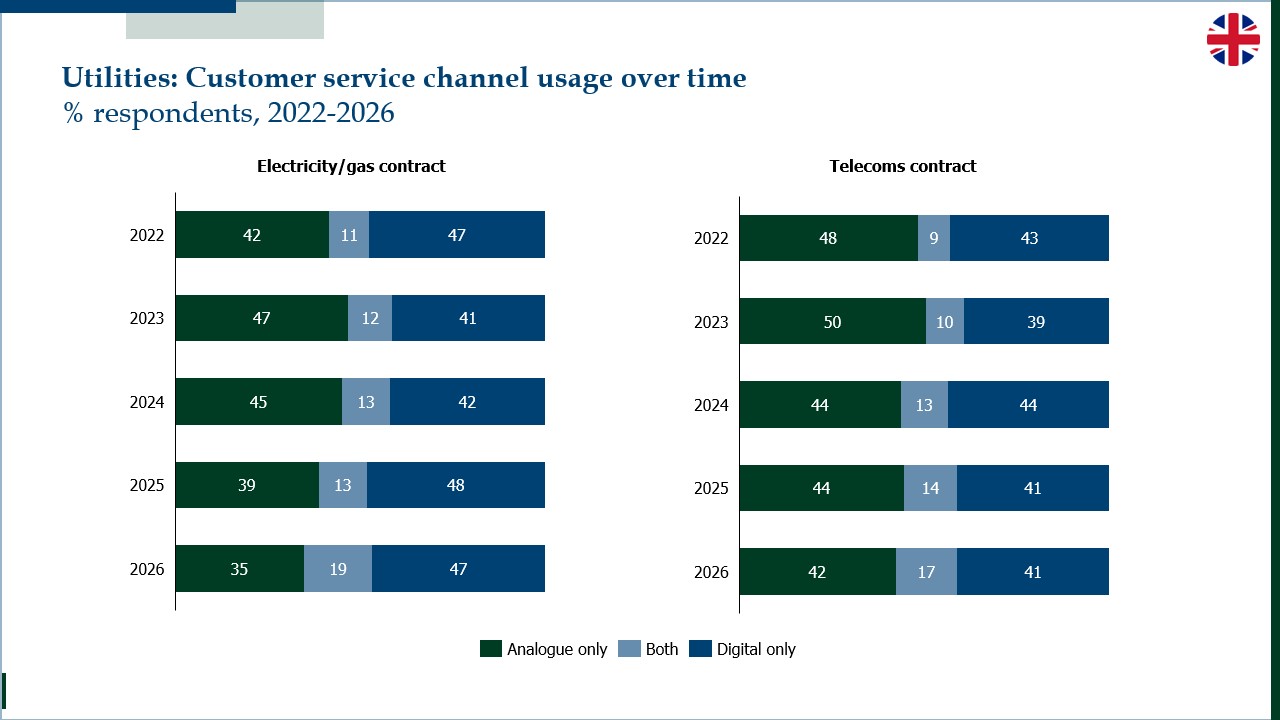
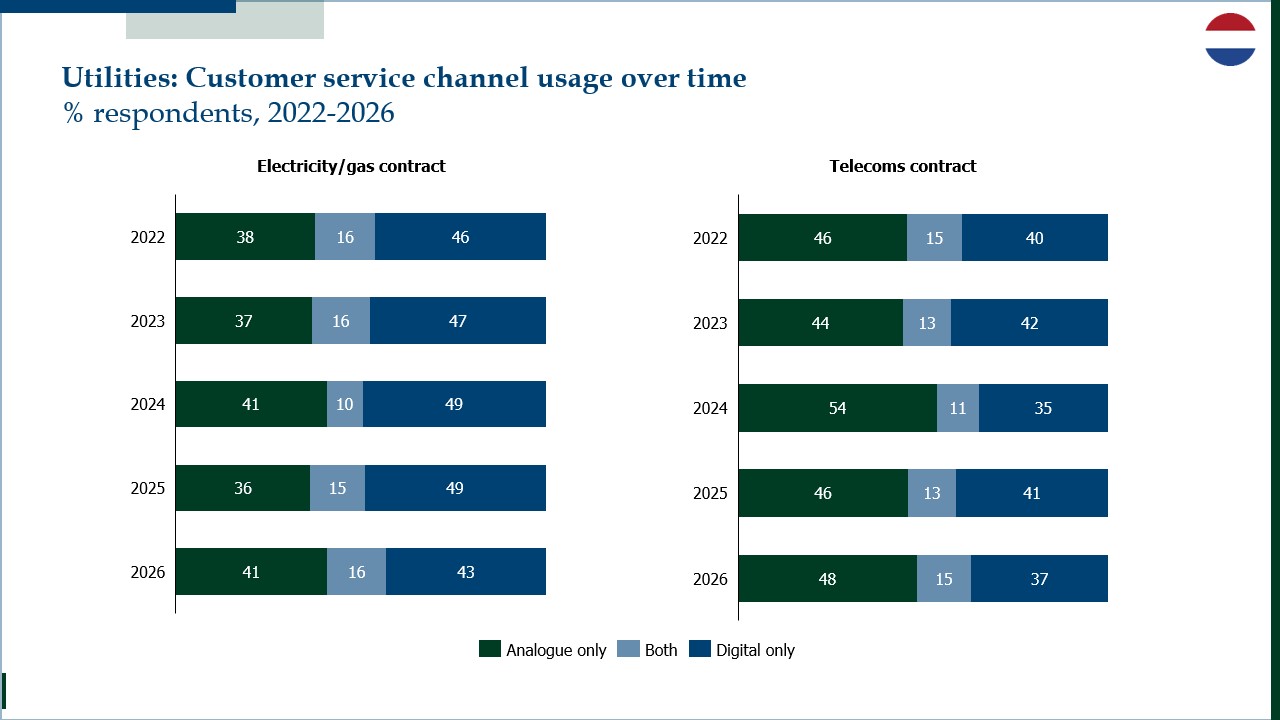
Despite strong online purchasing penetration, for customer service, around half of consumers in the UK and NL continue to use the telephone for all of the journeys, and one in ten go to a shop.
In the UK, analogue-only customer services have declined in usage over the past five years, but this has largely been replaced by a mix of digital and analogue, rather than digital-only. Around 50-60% of customer journeys still involve analogue channels at least in part. In the Netherlands, analogue-only channel usage for customer service in utilities has fluctuated around 40-50%, and overall is now higher than in 2021.
Dena McCallum, co-founder of Eden McCallum, notes that “online shopping for physical goods remains below 2021 in most categories and those numbers are not changing quickly or with a clear pattern.” And when it comes to customer service, the telephone is still by far the most popular channel. “Businesses have been investing in digital-only journeys for 10+ years, and yet the majority of customer service still involves humans at some point. AI, however, may see this long-expected shift to digital-only service journeys finally happen.”
Click here to see the full data for the UK results
Click here to see the full data for the NL results
Follow us on LinkedIn to remain updated