

Eden McCallum Consumer Survey: AI usage and attitudes, Q3 2026
The arrival of AI at work and in personal lives has already brought about dramatic change. Large language models and agents have revolutionised our world. But how are people reacting to this changed environment?
To answer this question Eden McCallum surveyed 2,000 people in both the UK and the Netherlands to get a sense check on how they are experiencing AI and their views about its future.
Our survey revealed that few remain in any doubt about the impact of the AI revolution. Frequent use of AI is already widespread, both at home and at work. There is a strong link between age, employment status, usage levels, training, and confidence, with the employed and the under 45s the highest users and the most confident.
But while many are enjoying the benefits of new AI-enabled possibilities, not everyone is so enthusiastic about all the changes they are seeing in the world around them. While over three quarters of those aware of AI expect it to have a significant impact on society within one to three years, with most optimism for health, innovation and information, half expect the effects to be mixed, and expectations are net pessimistic for privacy, human connection and jobs. And who will steer us through the change? Trust in institutions to regulate AI is lukewarm across the board, and there is surprisingly little difference in trust levels between AI companies, governments and international bodies.
(A note on timing: our survey was conducted over the summer, and checked again in the autumn after the dangers of AI became front page news; we found that sentiment had not significantly shifted over that period.)
Impact on society
Three quarters of those surveyed felt AI would significantly impact society over the next one to three years, with views on how that will play out very much split between optimism and pessimism, with the strongest pessimism expressed by the over 45s and those who are not working.
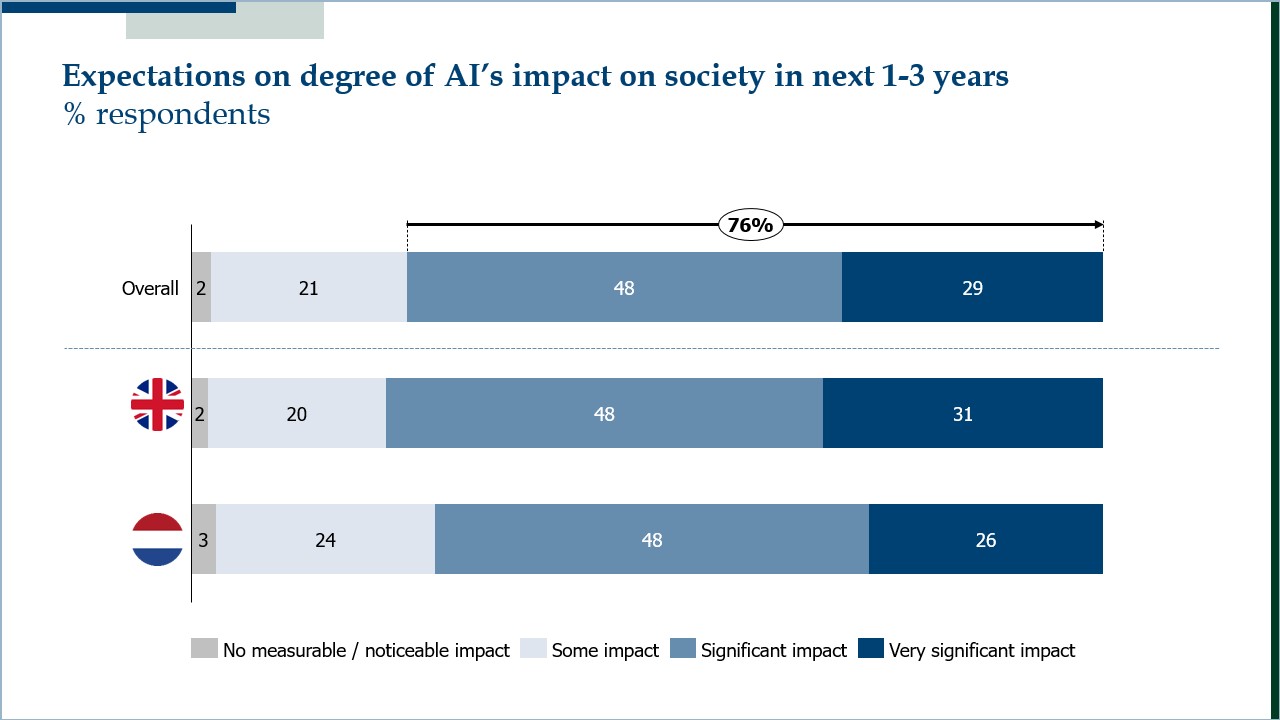
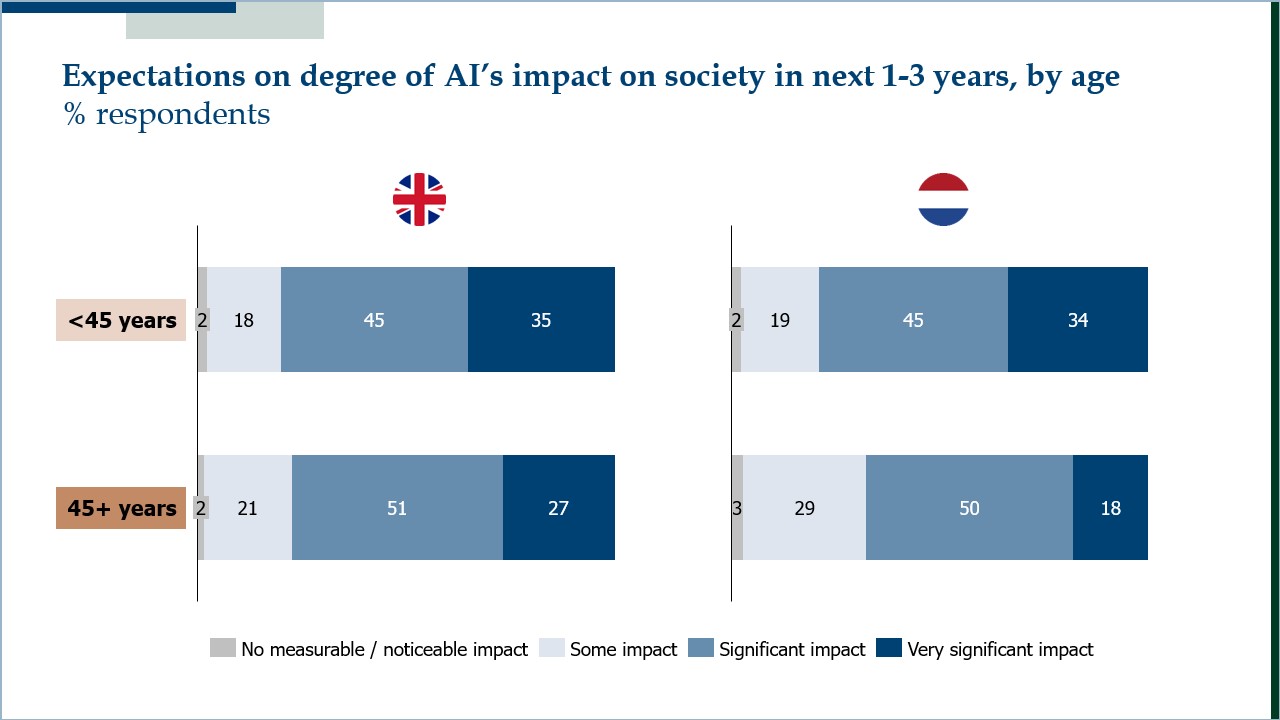
Under 45s in both countries are more likely to expect significant impact, with the difference especially pronounced when we look at intensity of impact – in the Netherlands, almost twice as many younger respondents expect the near-term impact to be very significant.
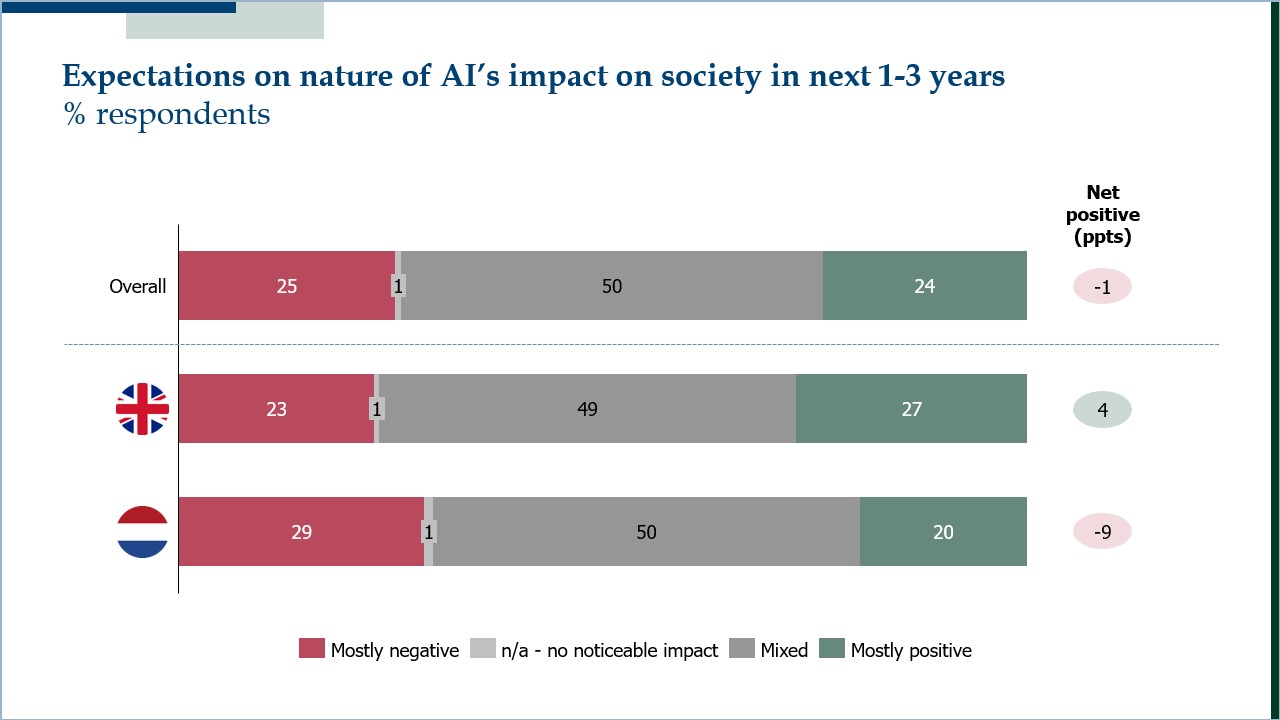
When it comes to the nature of that impact, half of respondents feel AI’s impact will be mixed and nearly a quarter each lean to positive or negative; the UK leans somewhat more positive (net 4 ppts), while in the Netherlands negative expectations outweigh the positive by 9 ppts. The employed are most positive about the potential future impact of AI on society, particularly in the UK. And younger Brits are by far the most positive about AI’s future impact on society (a net positive score of 30 points). The equivalent net positive score for Dutch under 45s is only 1%. The over 45s are negative (almost 20 points net negative) in both countries.
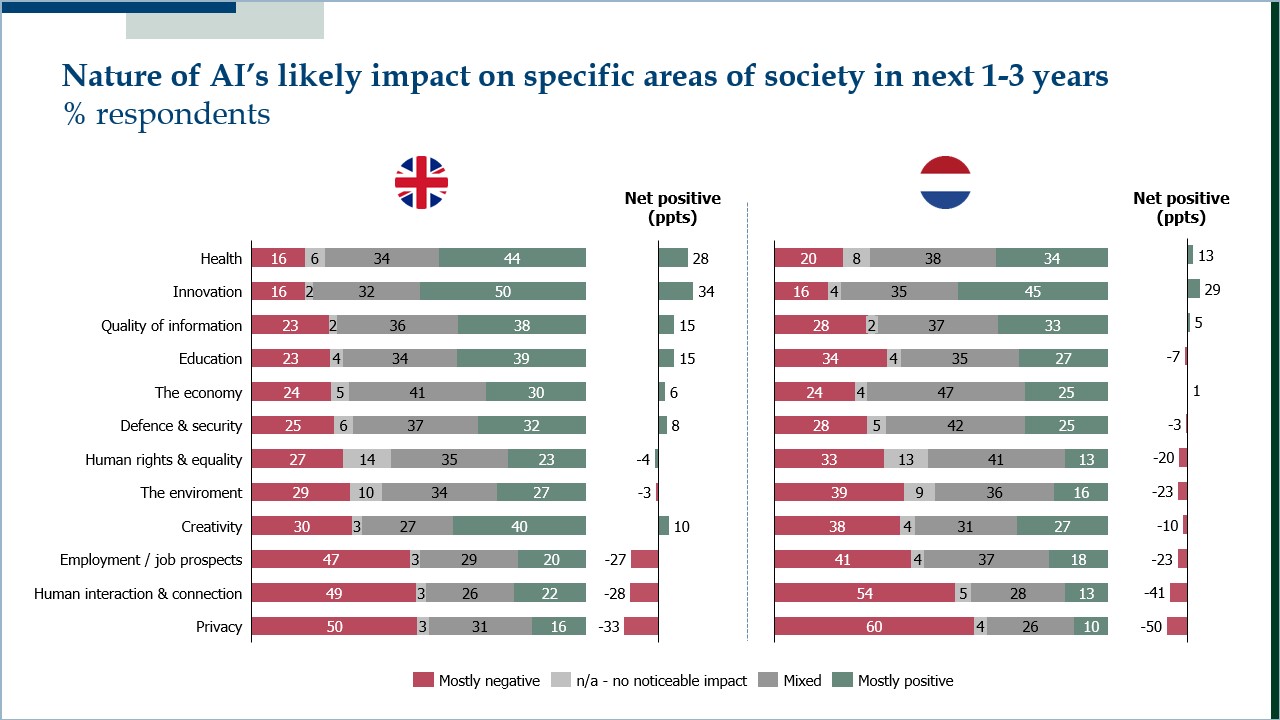
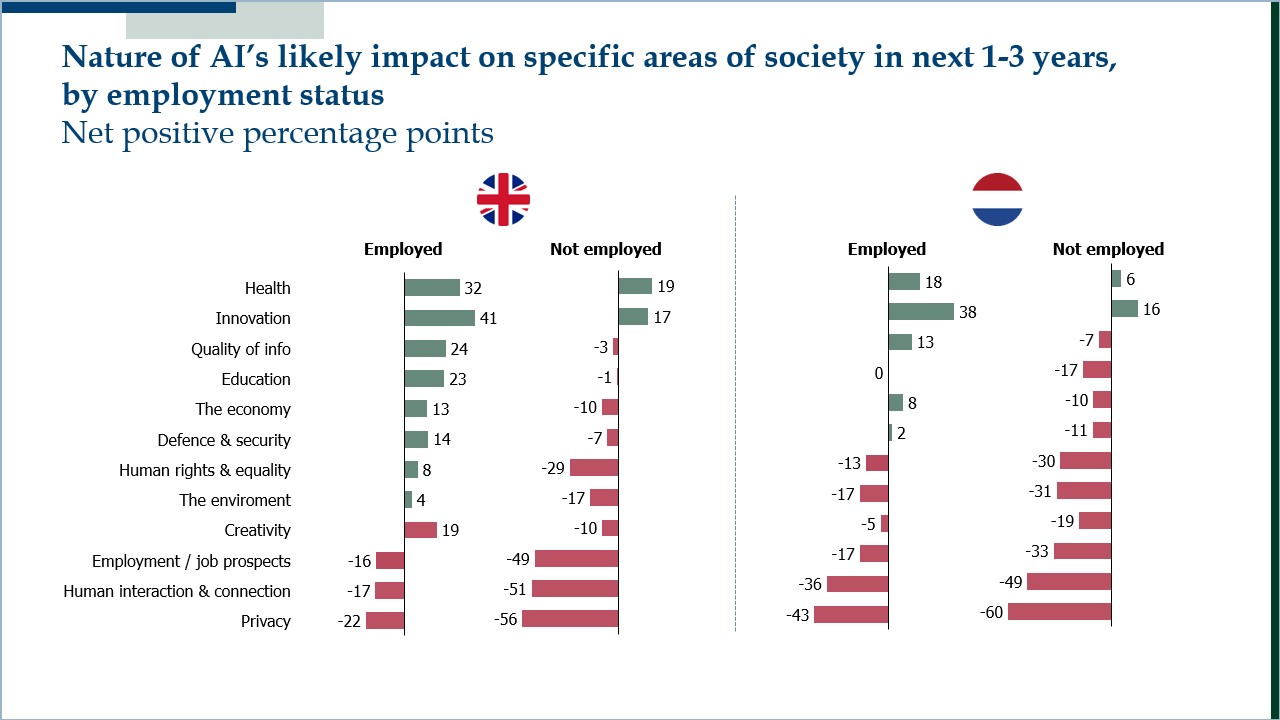
Expectations about AI’s future impact on different aspects of society vary. There are more positive expectations in both countries for the impact on health, innovation and the quality of information, but more pessimistic views about the consequences for privacy, human connection and jobs. One notable difference is on the question of creativity: the Brits expect a positive impact overall (10% net positive) while the Dutch hold the opposite view (10% net negative). Dutch respondents have more negative expectations on AI’s impact for all aspects of society – and in particular are much more concerned about the consequences of AI on human rights / equality, and the environment.
In both countries those who are not employed are more pessimistic than the employed about the impact of AI on all areas of society.
A question of trust
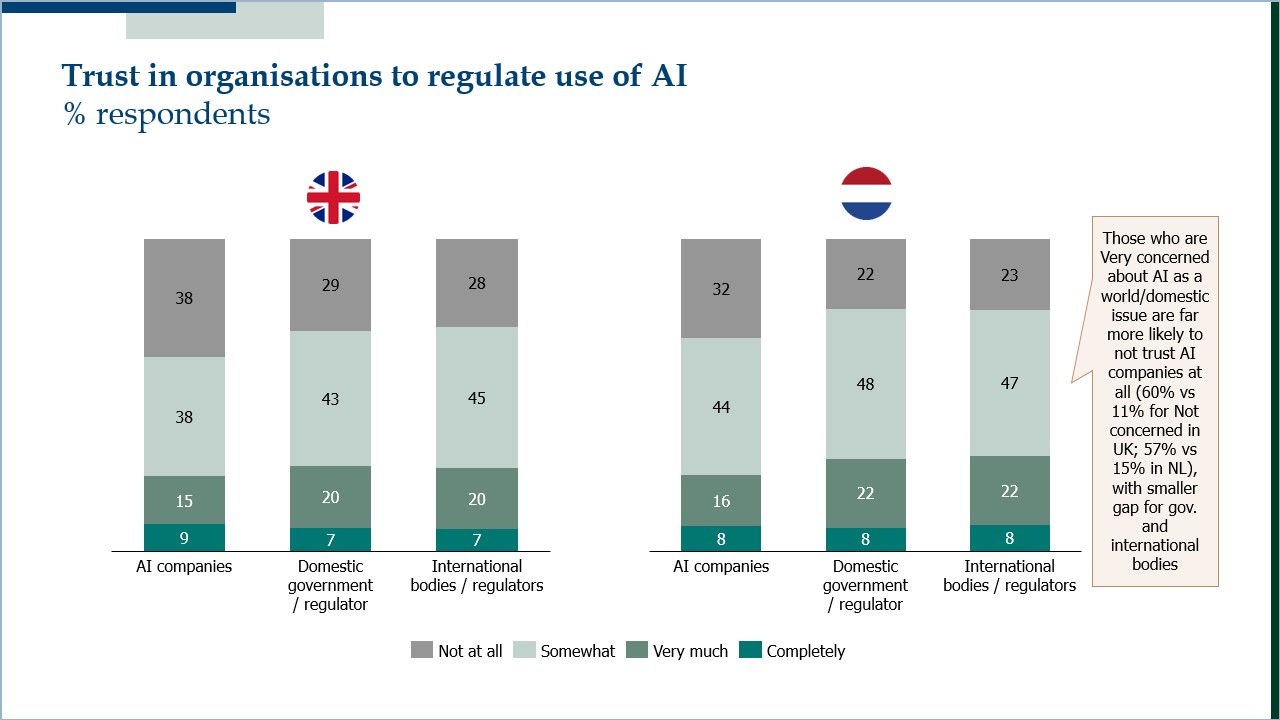
There is limited trust among all respondents in the capacity of organisations to regulate AI. Under three in ten trust any organisation completely or very much. Somewhat surprisingly, governments and international regulators are not trusted any more than the AI companies.
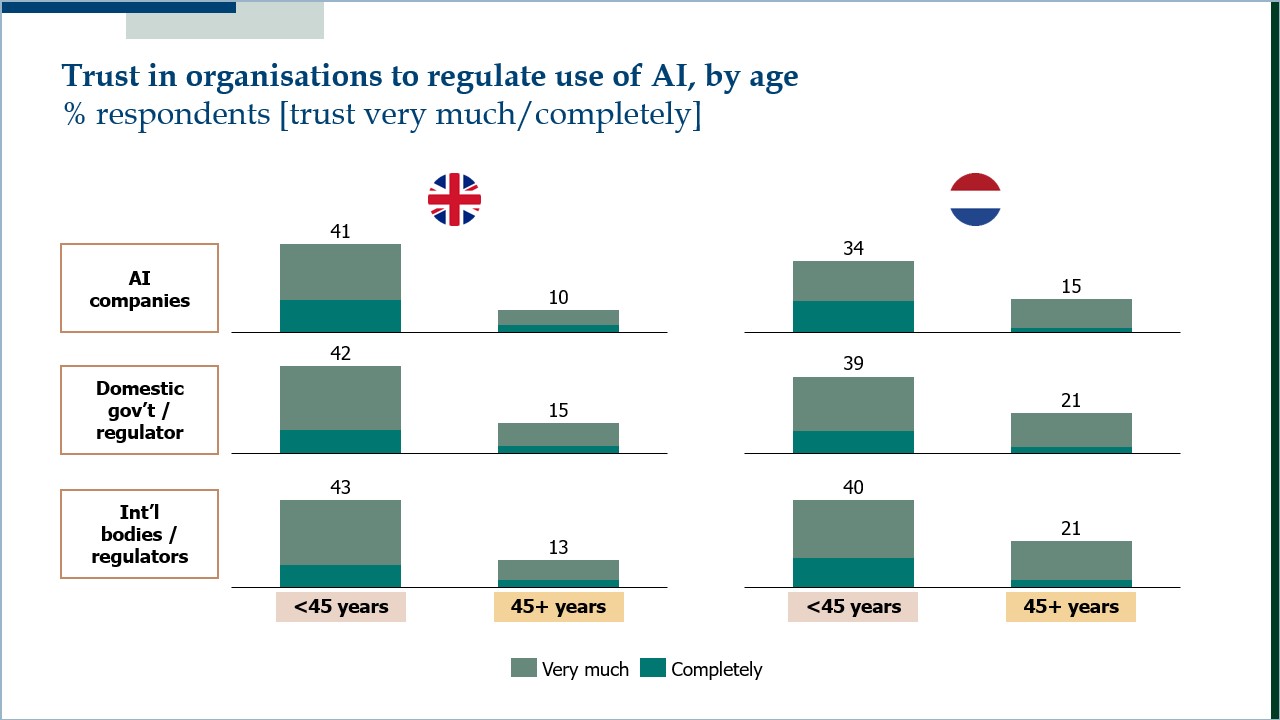
The under 45s are much more trusting of organisations to self-regulate – particularly in the UK, where there is a startling 30 percentage point gap in trust levels between the more sceptical over 45s and the more hopeful under 45s.
AI and personal lives
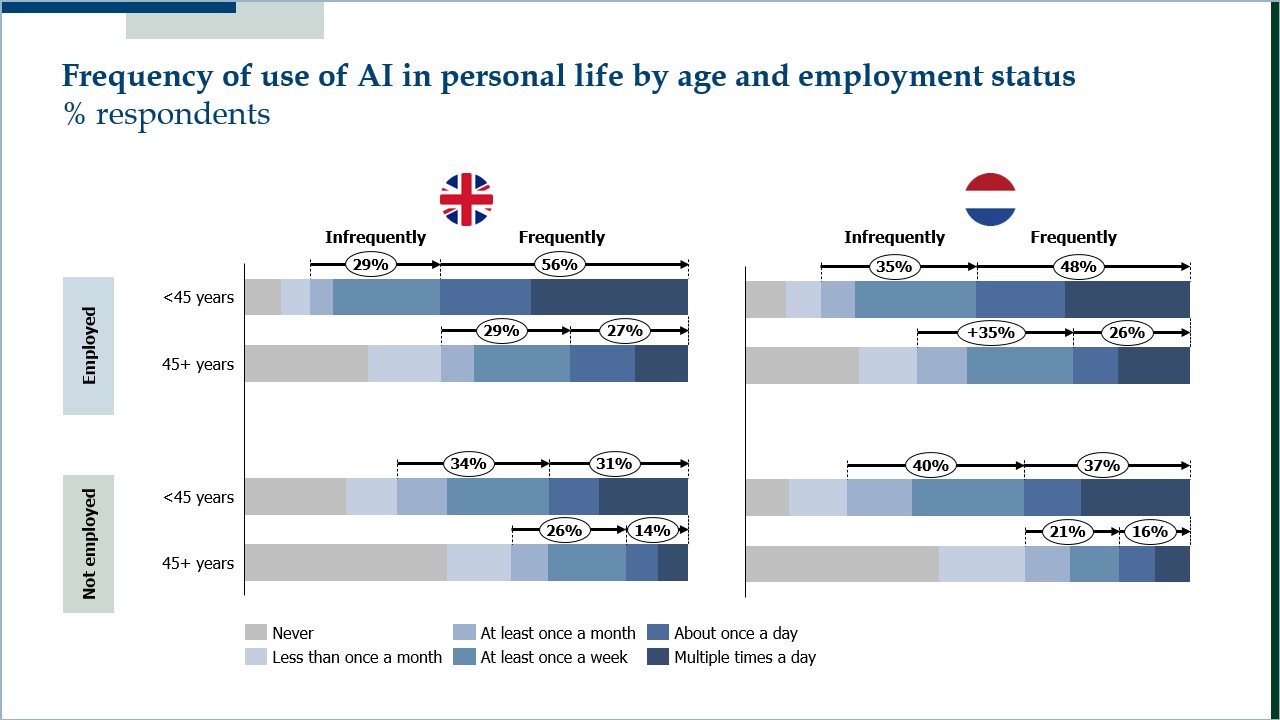
As far as people’s use of AI in their personal lives is concerned, over one third are using AI at least daily, with a further 30% less frequently (at least once a month).
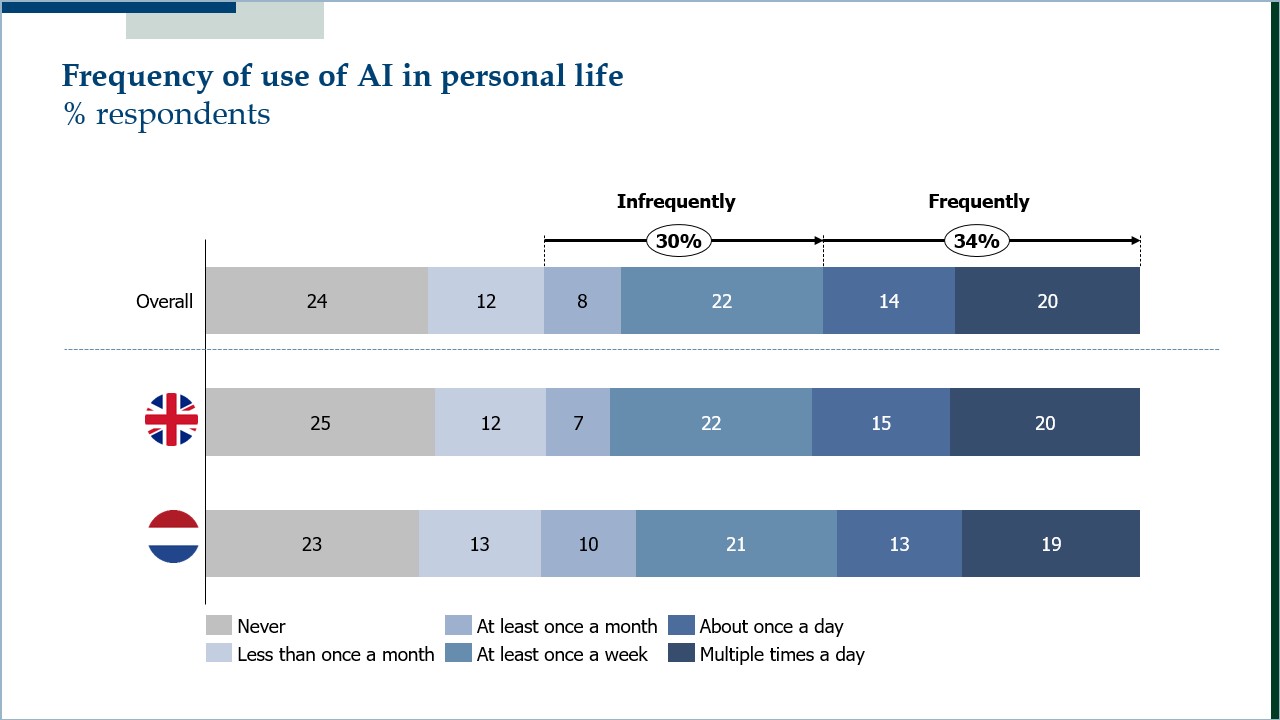
People who are employed tend to use AI more in their personal lives than those who are not (and at roughly similar levels to their use of AI in their work). 44% of UK respondents who are employed (39% of the equivalent Dutch cohort) use AI frequently in their personal lives. Only 17% of those in the UK (22% in NL) who are not employed make equally frequent use of AI.
In both countries, the under 45s are the most frequent users of AI in their personal lives, with more than twice as many using it at least daily than the over 45s. This difference in usage applies whether respondents are employed or not employed.
Why are some choosing not to use AI in their personal lives? Lack of trust in sharing data with AI tools and lack of trust in the answers it provides are the main reasons for the reduced take-up.
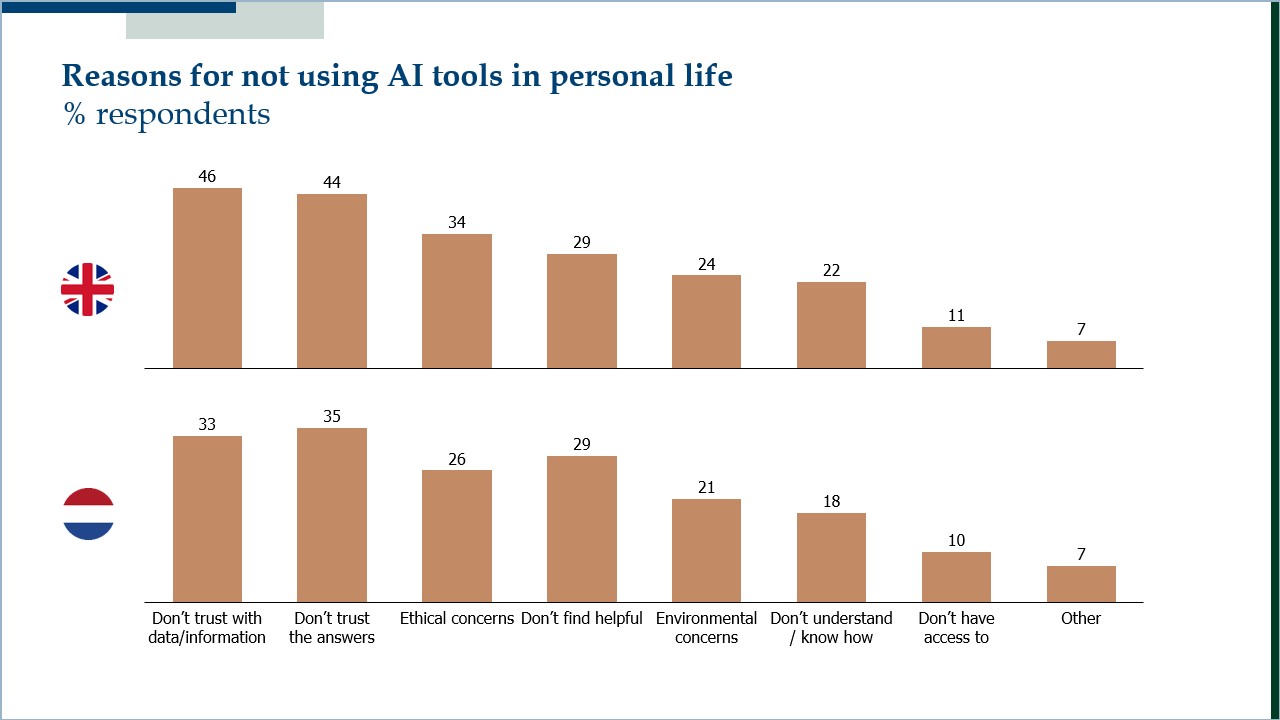
Those not employed are more likely not to use AI because of a lack of understanding – a similar cause of lower use by the over 45s. Under 45s are more likely than older adults to not use AI because of concerns over its environmental impact and ethics.
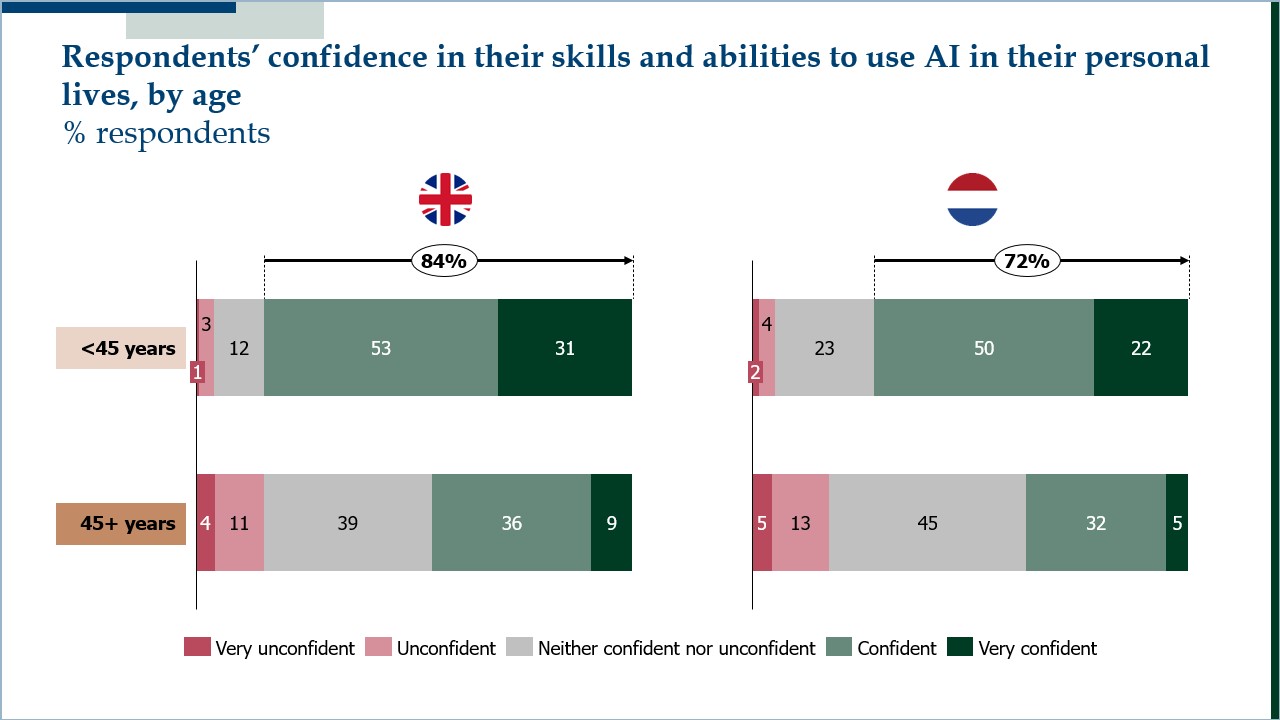
Those who do use AI in their personal lives are quite confident in using it (around 60% in both countries feel this way). However, evidence of an age gap can be seen again here: 31% of UK under 45s and 22% of Dutch under 45s are very confident in their use of AI, whereas those confidence levels are reported only by 9% of UK over 45s and 5% of Dutch over 45s.
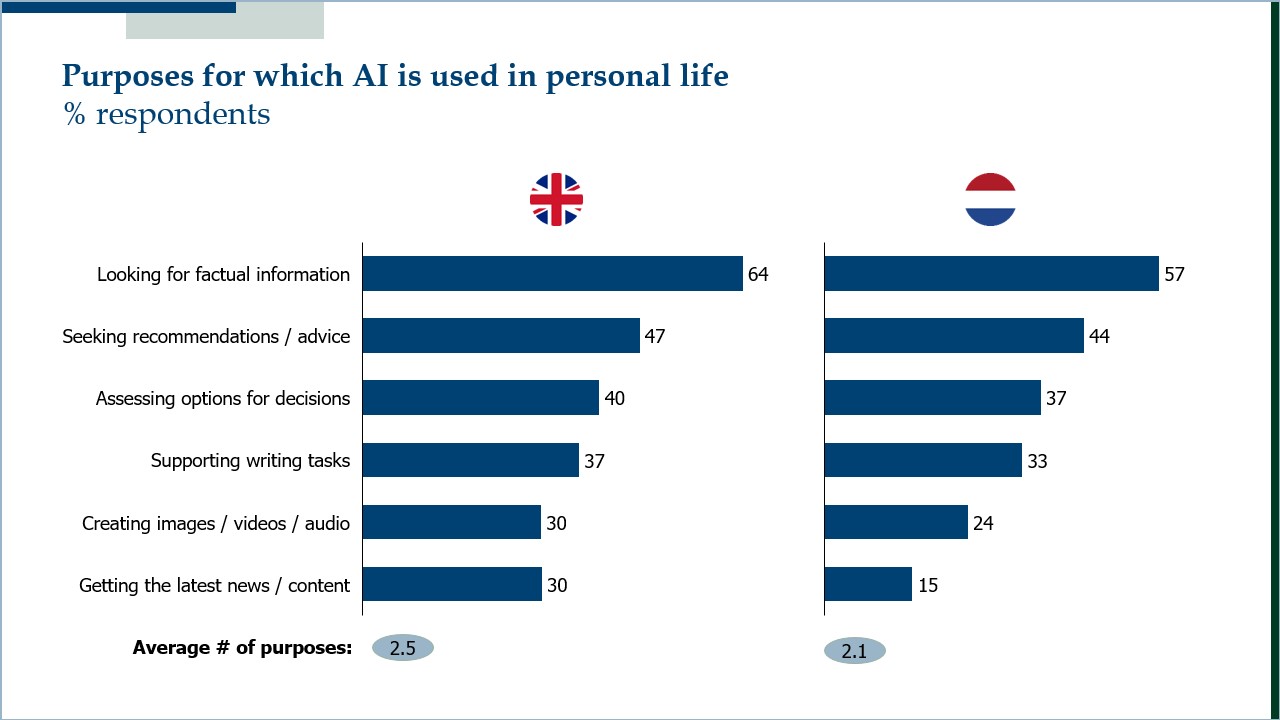
In both countries, AI is most often being used for looking for factual information (around 60% say so), seeking recommendations or advice (c 45%) and assessing options to help make a decision (c 40%). Younger people use AI for a wider range of purposes (for example, help with writing), which links with their higher usage levels.
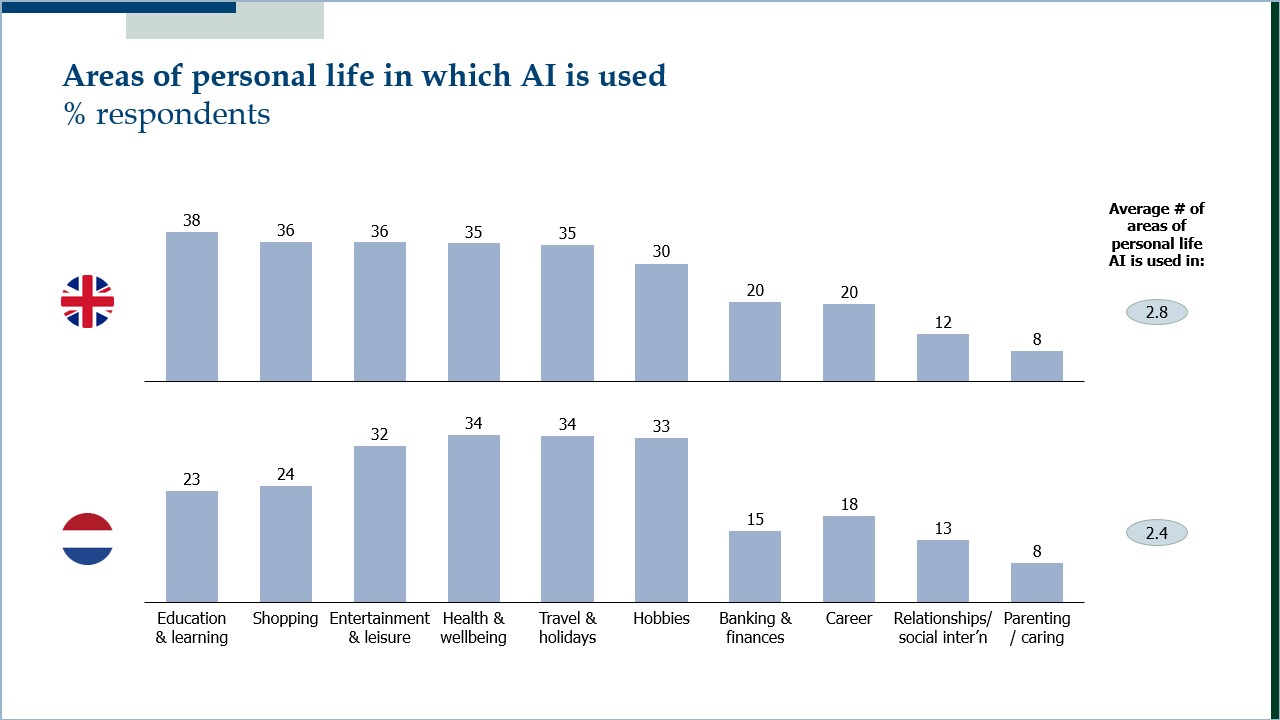
AI is being used across a wide range of different aspects of people’s personal lives, with Education and Shopping the most cited in the UK, and Health/Wellbeing and Travel the biggest in the Netherlands. The employed and under-45s are using it more broadly than others.
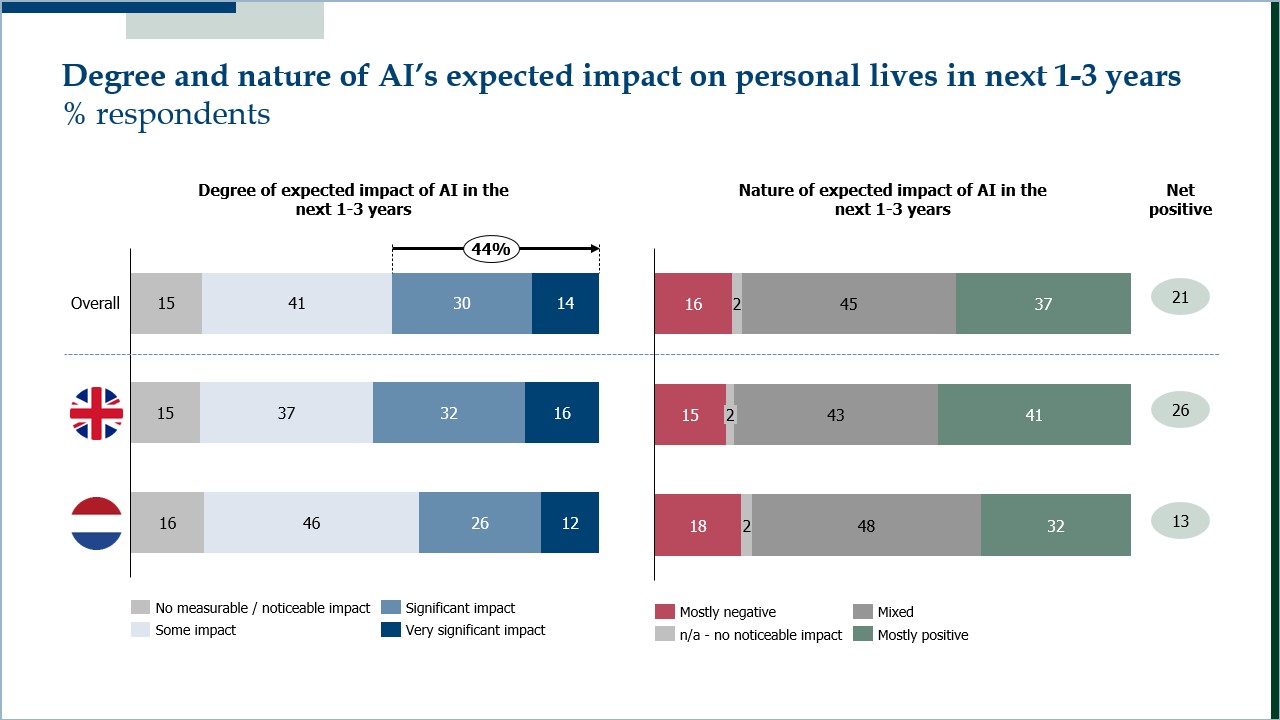
As far as the future is concerned, nearly half of UK and over one-third of NL respondents expect AI to have at least a significant impact on their personal lives in the next one to three years. And respondents are much more positive about the future impact of AI on their personal lives than they are about its likely impact on society, with positive expectations beating negative ones by a significant margin (37 to 16 overall), particularly in the UK (41 to 15).
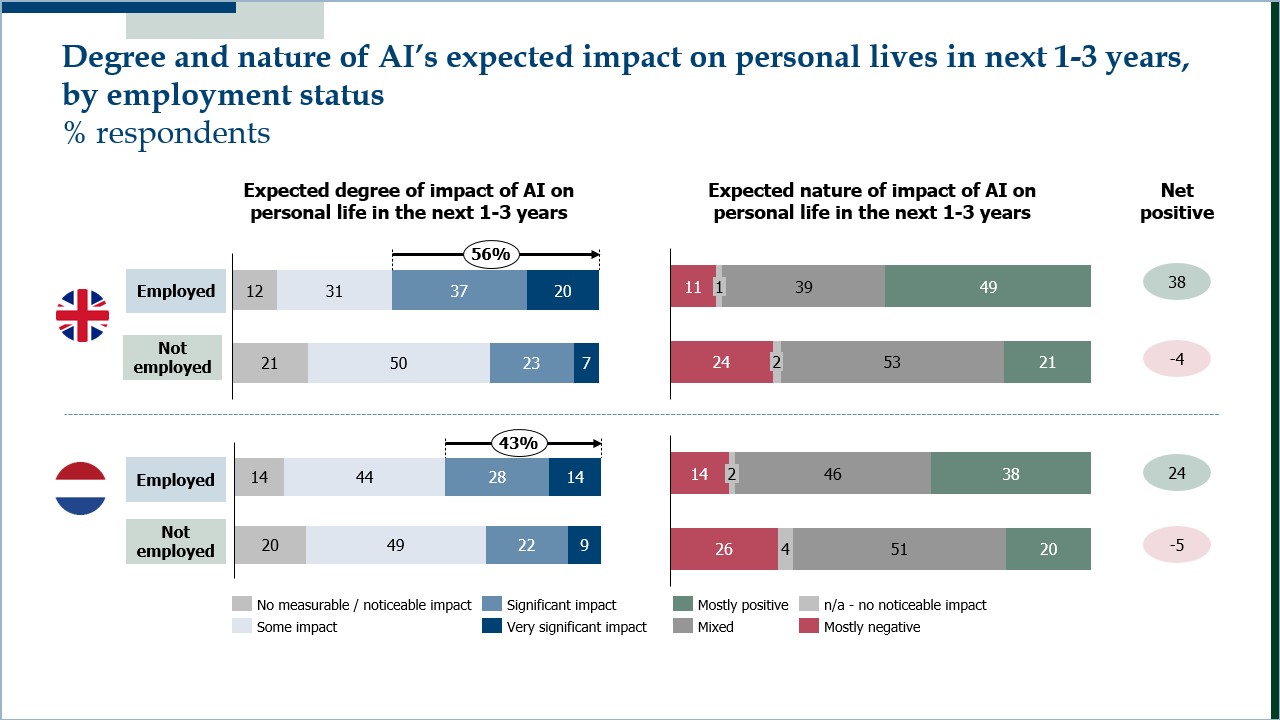
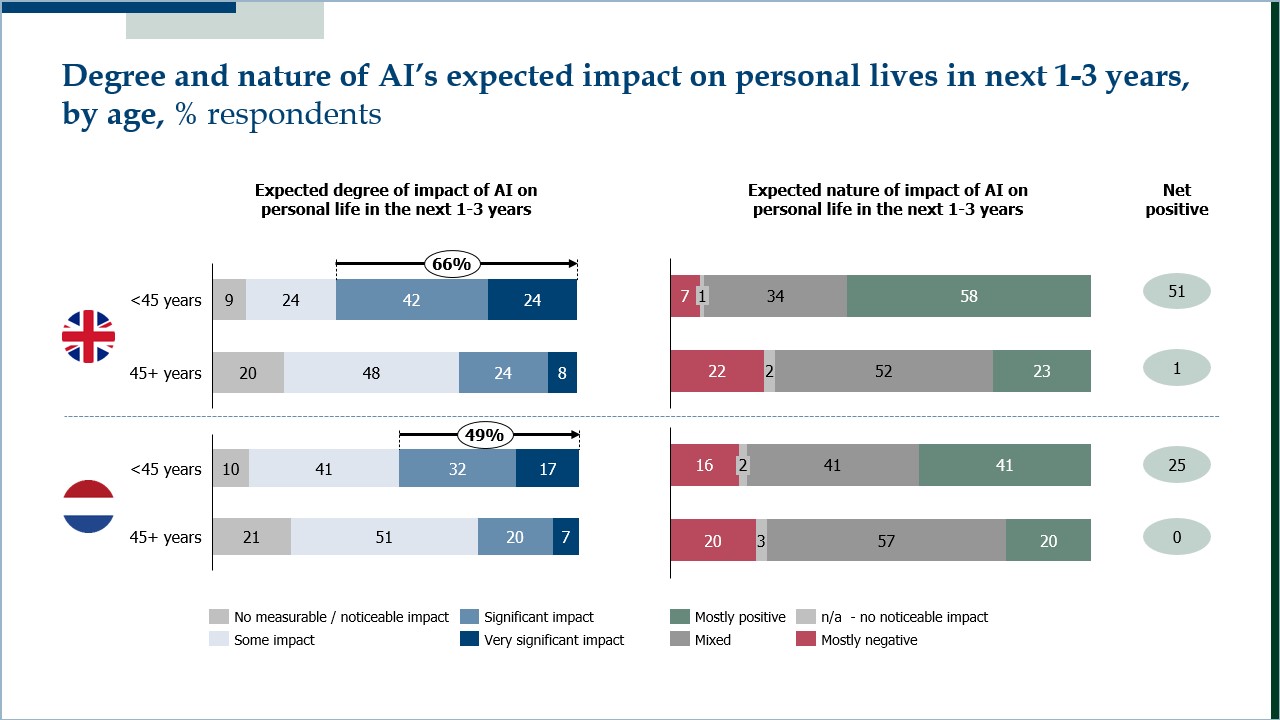
There are sharp differences in expectations based on employment status and age. Those who are employed and the under 45s expect much greater impact on their personal lives, and are far more positive about it, particularly in the UK.
AI and the world of work
Overall, AI is used daily by four in ten workers and a further quarter at least monthly. Managers use it far more frequently than non-managers: over half of managers use it daily.
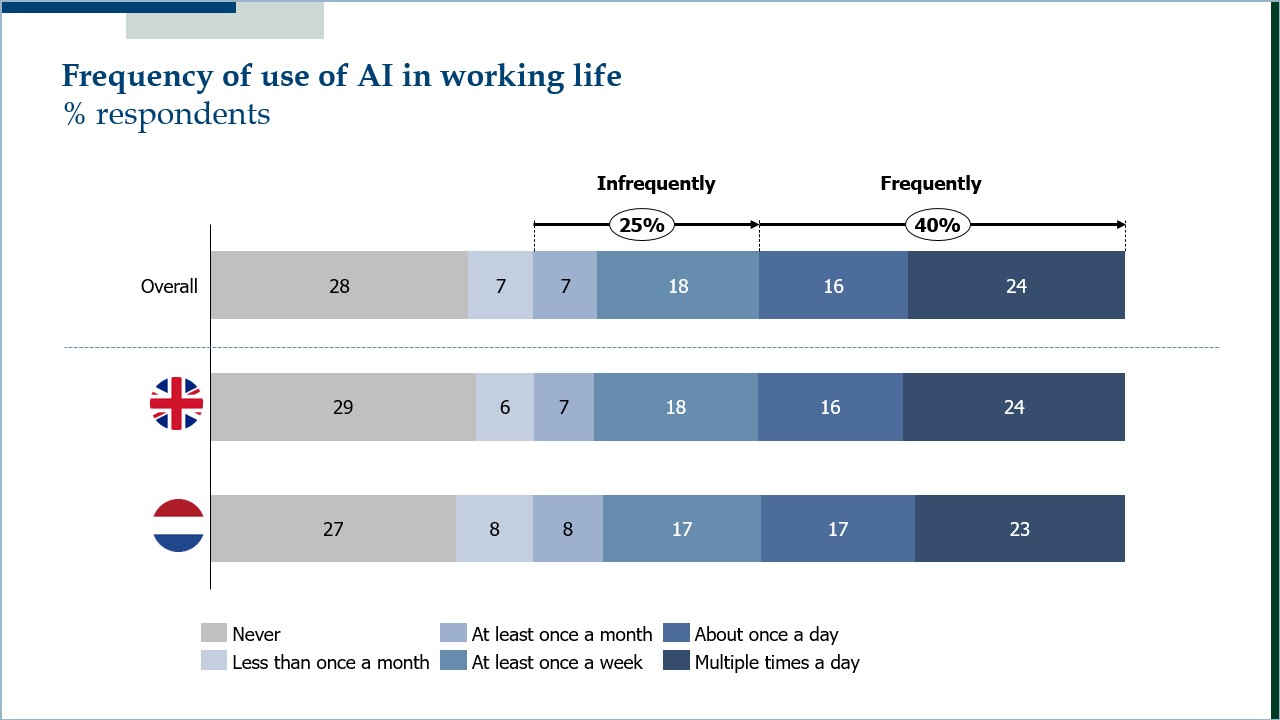
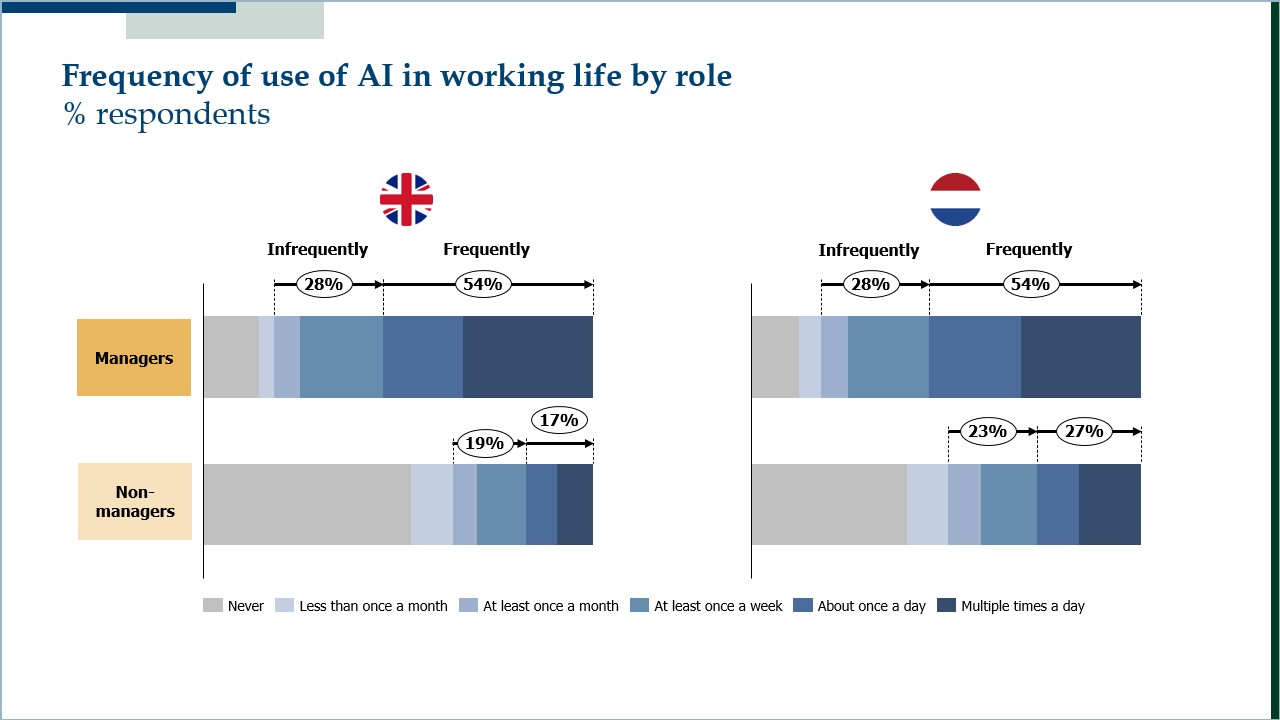
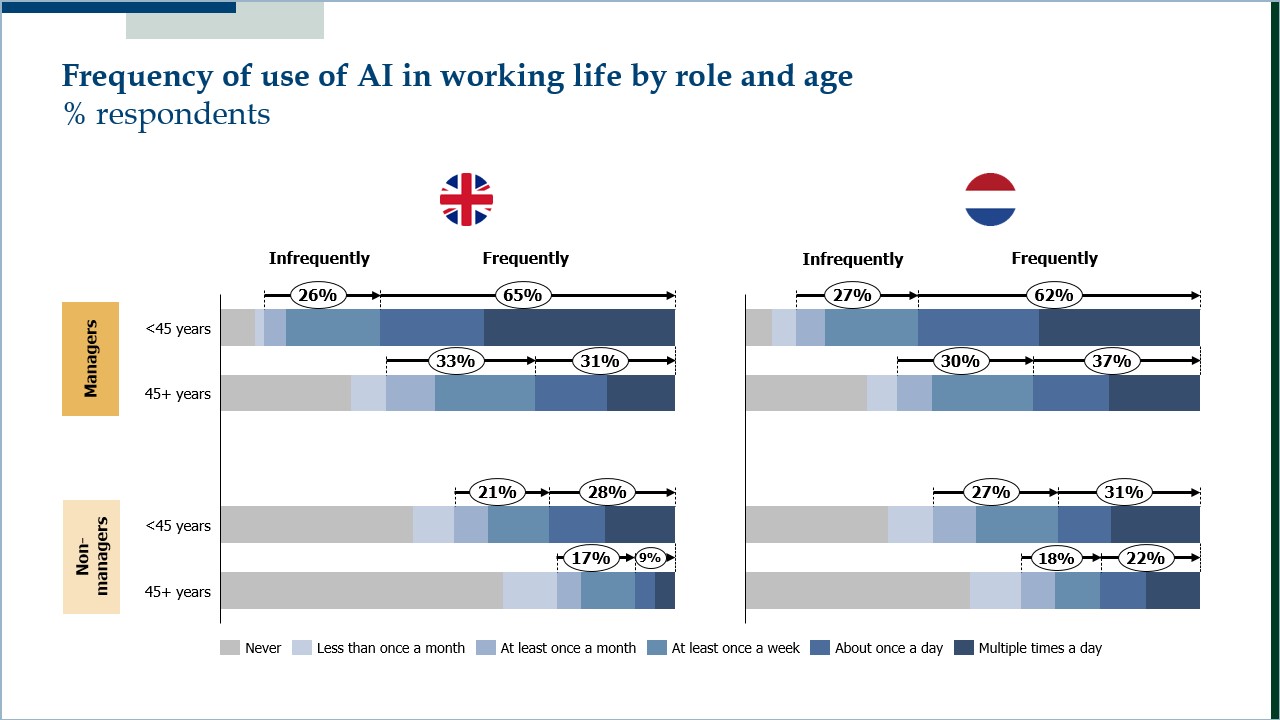
There is also an age difference in usage: 54% of under 45s in the UK use AI daily at work, with only 20% of over 45s doing so. In the Netherlands 48% of under 45s use AI at work daily, while only 27% of over 45s do so. Younger managers are using AI in the workplace most, while older managers are using AI more frequently than non-managers of all ages.
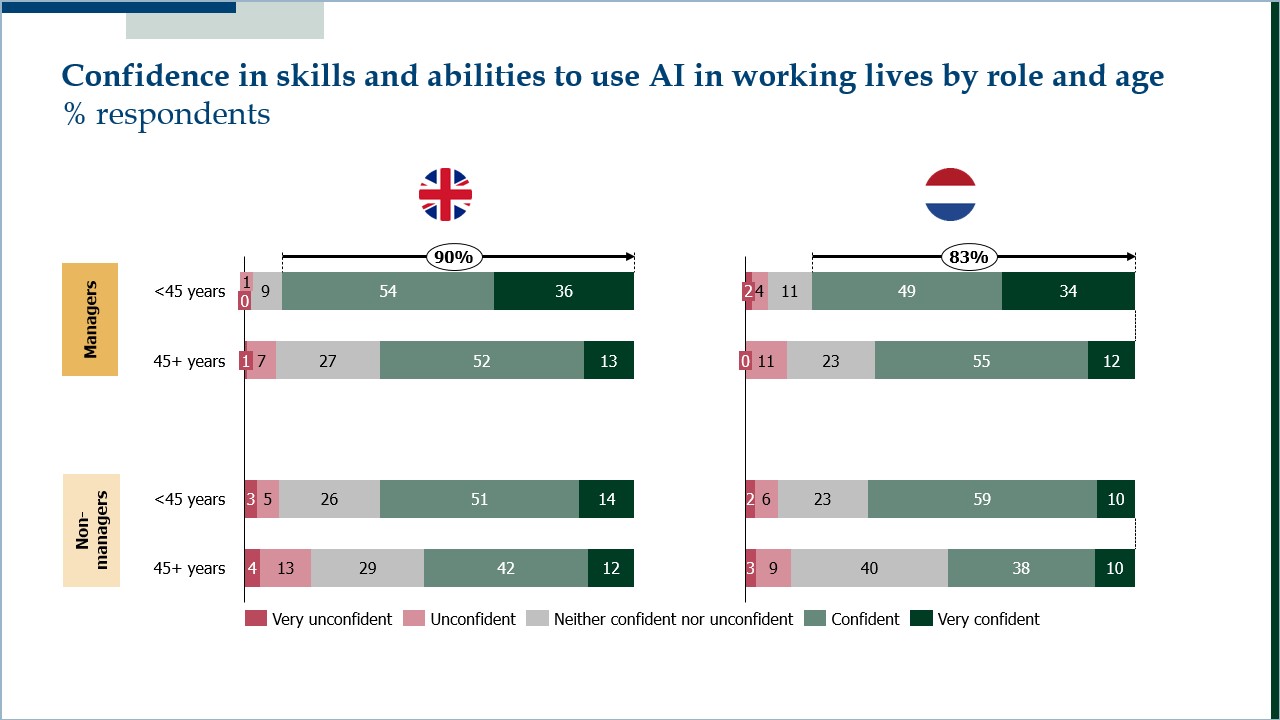
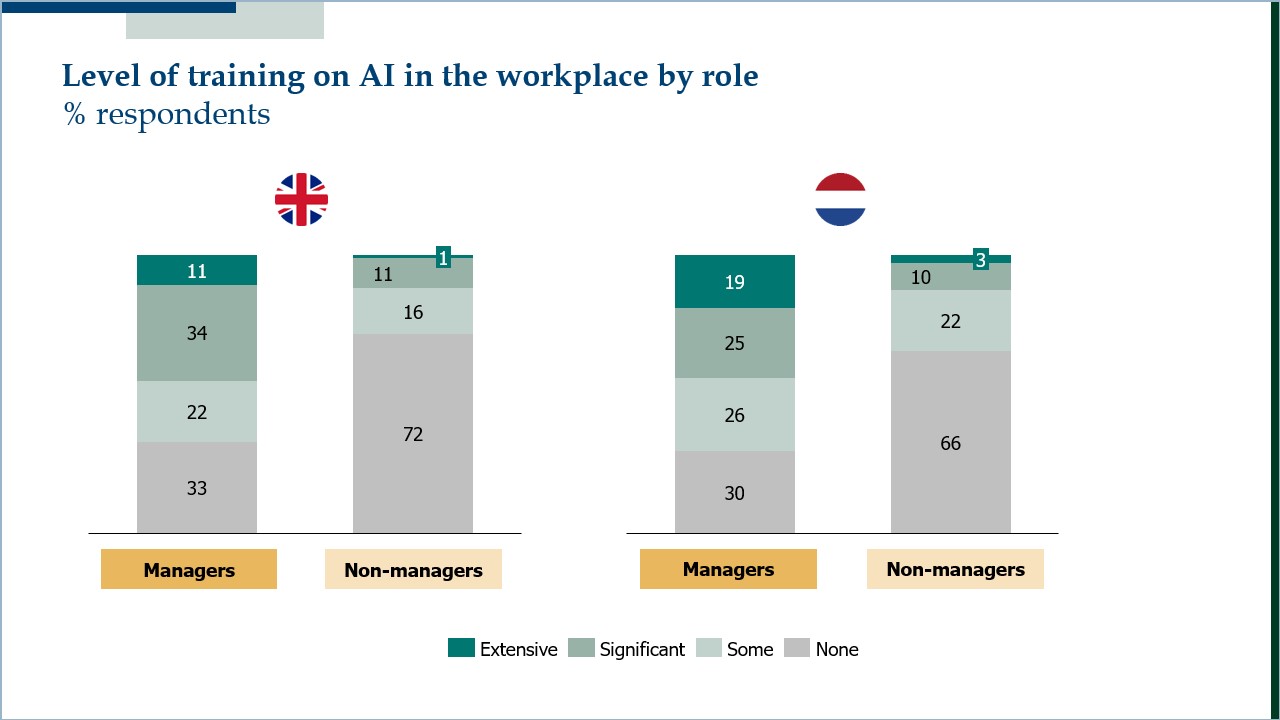
There are already high levels of confidence in using AI at work. Three quarters of those using AI in their working lives say they are confident doing so. Younger managers are the most confident. This links with training: just over half of our respondents have had at least some training in AI in the last year at their work, with the level of training much lower for non-managers.
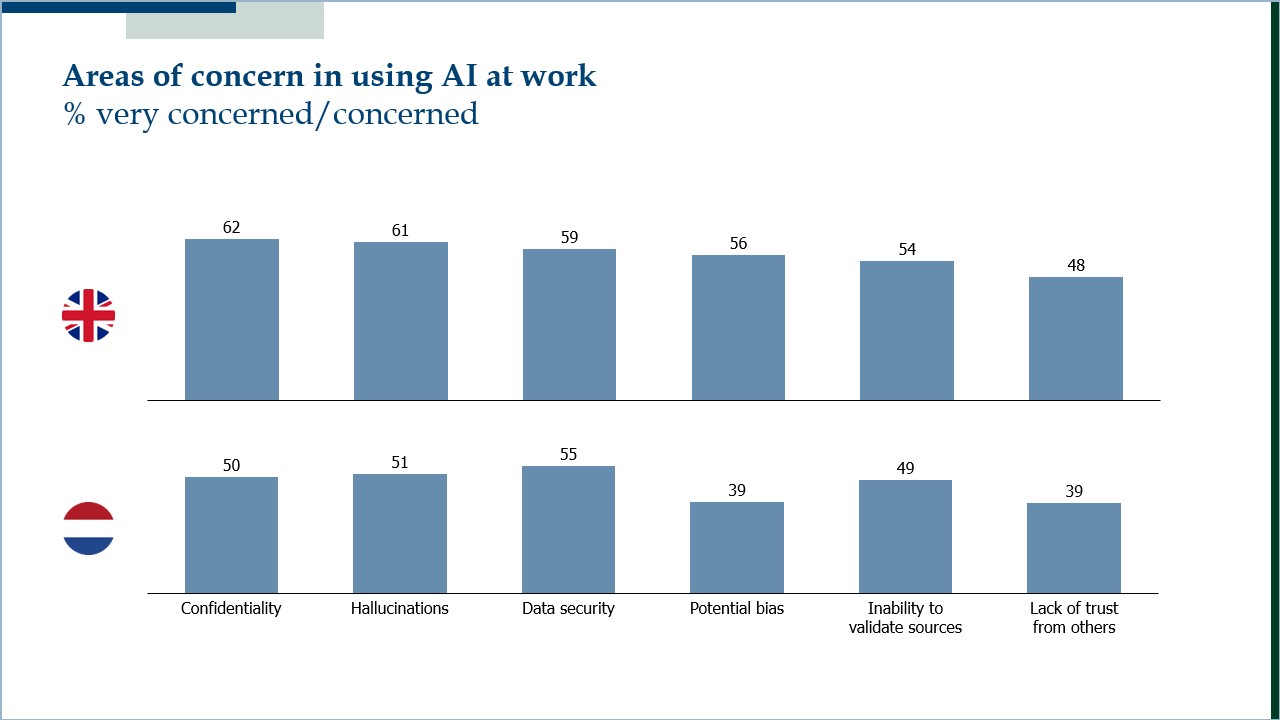
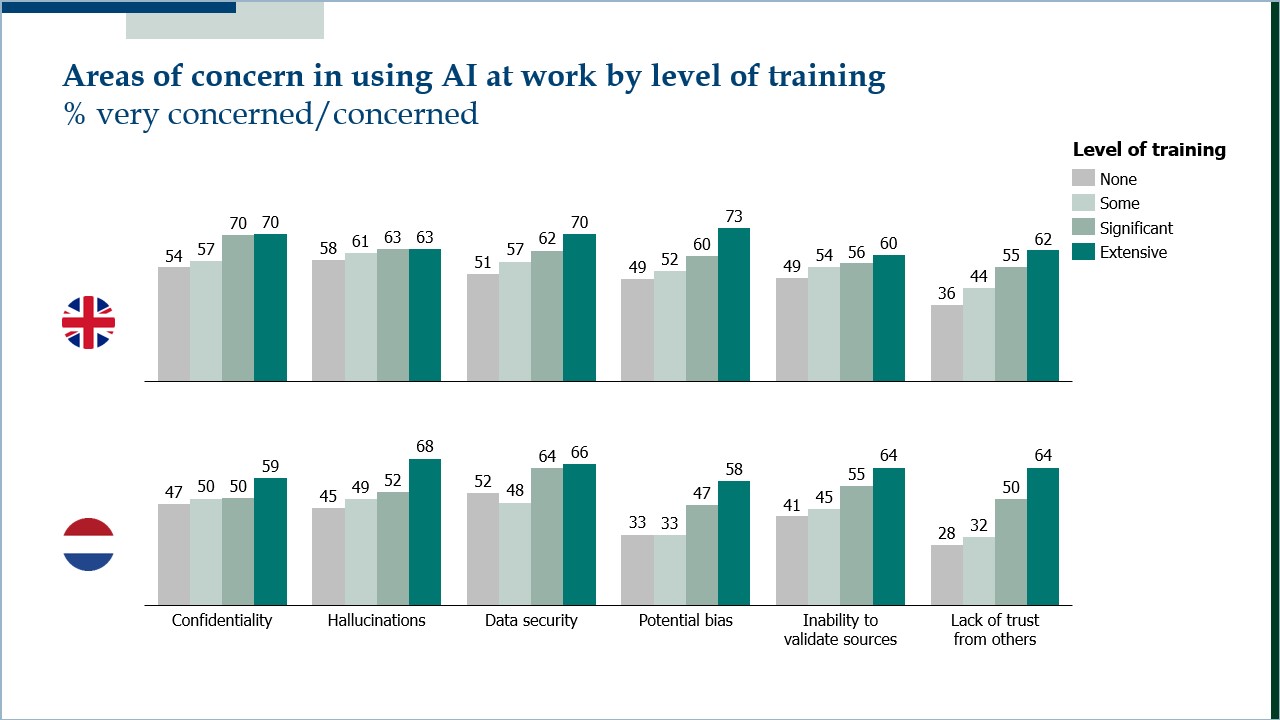
In terms of what worries people at work about using AI, respondents were most concerned about confidentiality, hallucinations, and data security, and interestingly the more that people had received training the higher their concern levels.
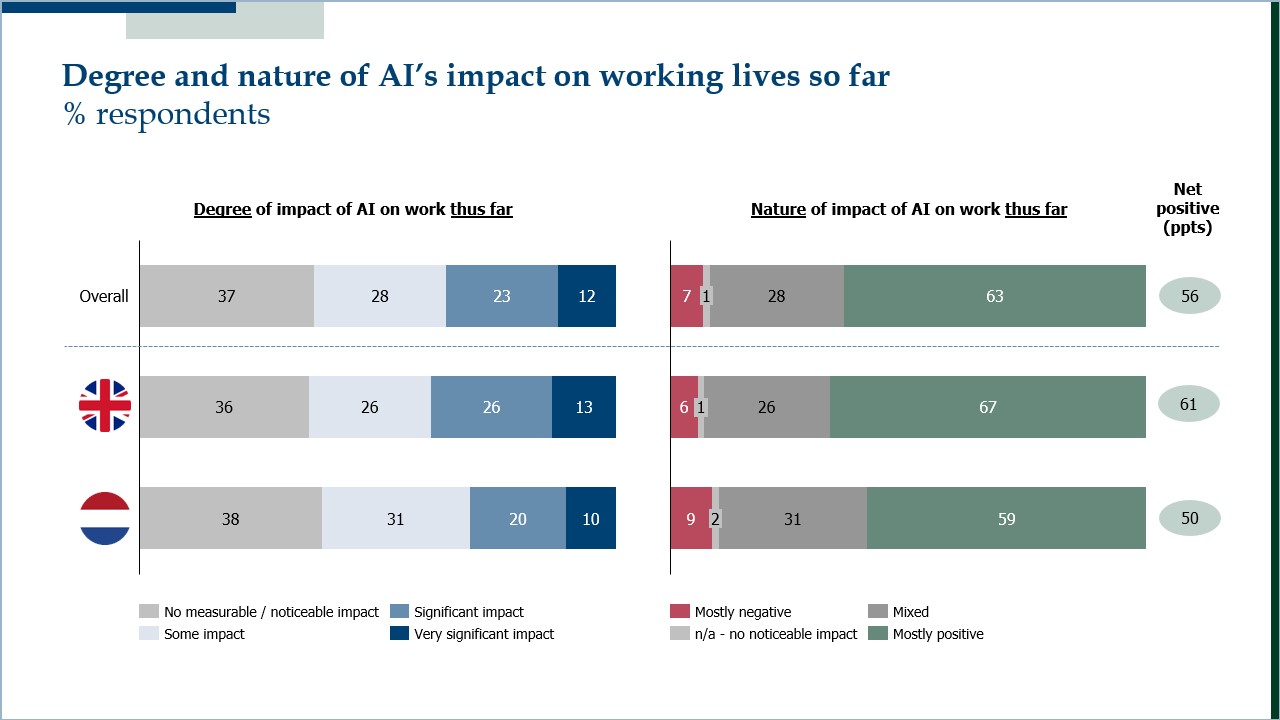
Around one third feel that AI has already had a significant impact on their own work, and about 60% of those impacted see it as mostly positive. Those who had had most training were much more positive about AI’s impact on their work (despite their higher levels of concern on specific issues). Managers report a much greater impact of AI on their work so far than non-managers, and are more positive about it. Younger workers also report a greater impact from AI on their work and are more positive, particularly in the UK, where 73% see it as a mostly positive development and hardly anyone (only 3%) sees it as mostly negative.
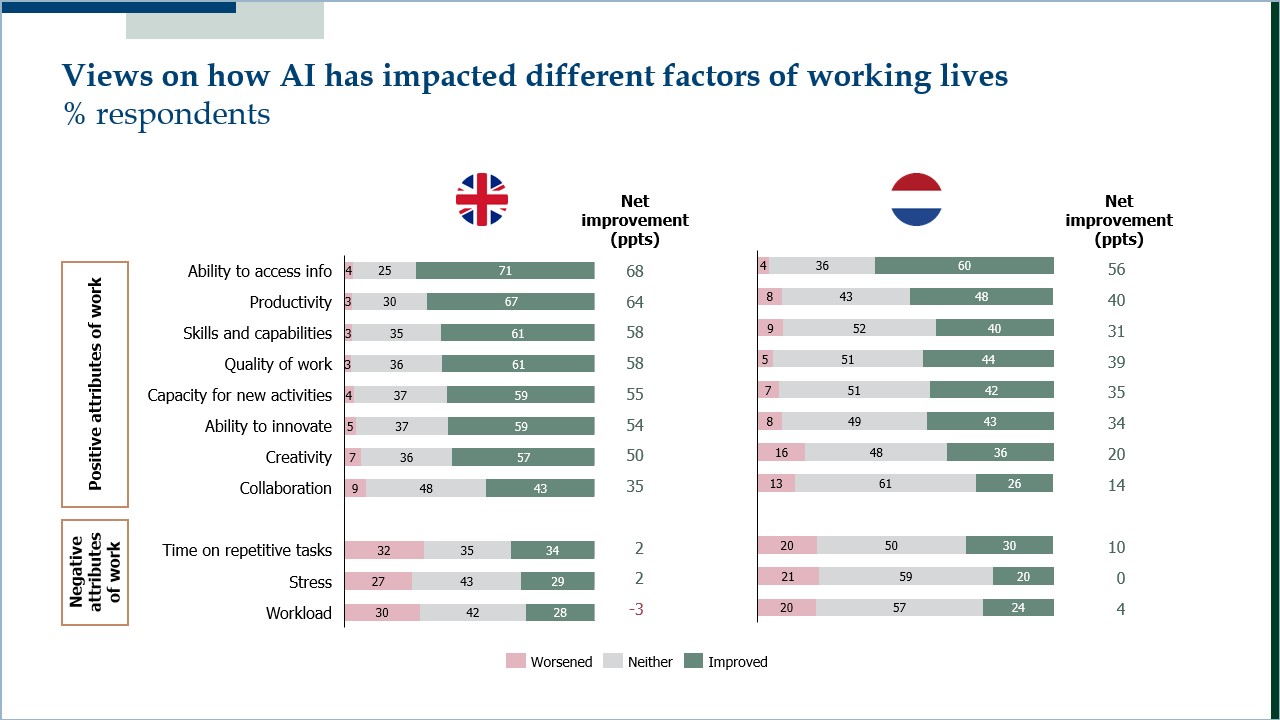
According to our respondents, AI has improved most factors of their work lives overall. Ability to access information, productivity, skills and capabilities and quality of work all feature prominently as improved areas. But a significant minority sees downsides in a few areas, particularly the extra time taken on repetitive tasks, stress and increased workload. Around three in ten UK respondents noted this, with about 20% of Dutch respondents feeling similarly.
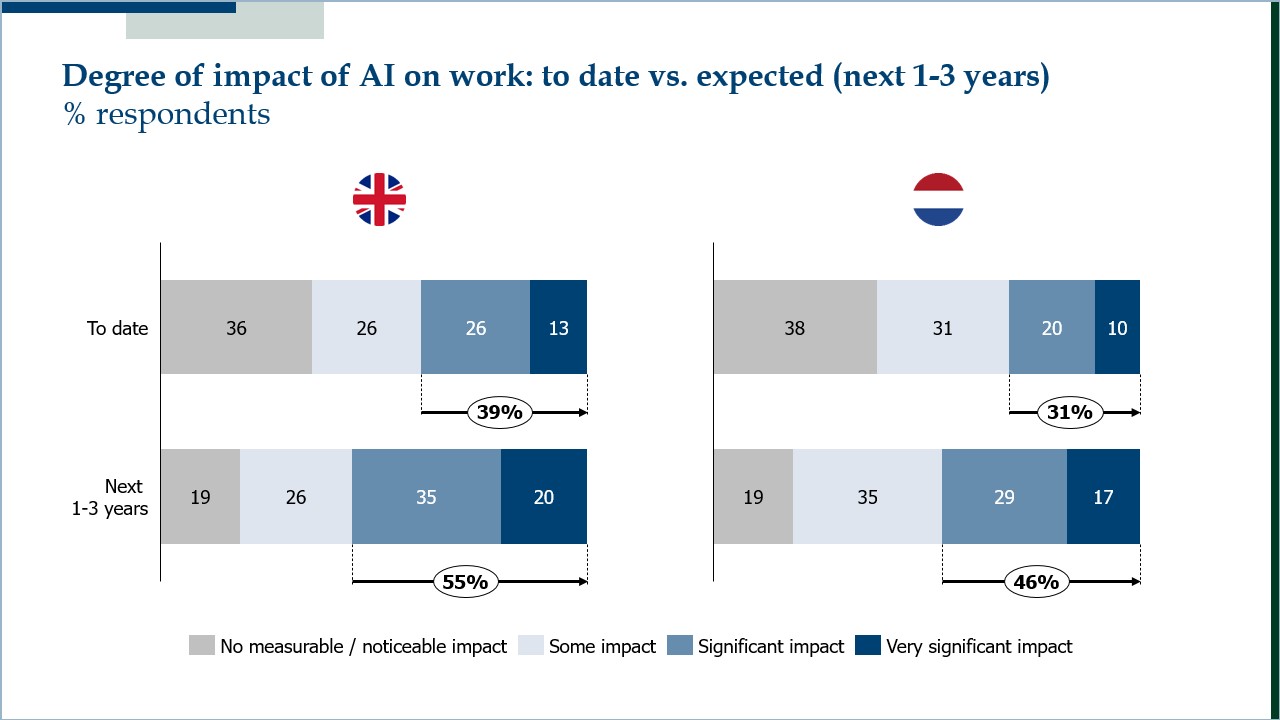
As far as the future is concerned, workers in both the UK and the Netherlands are expecting AI to have a more significant impact in the next one to three years on their work than has been the case up until now.
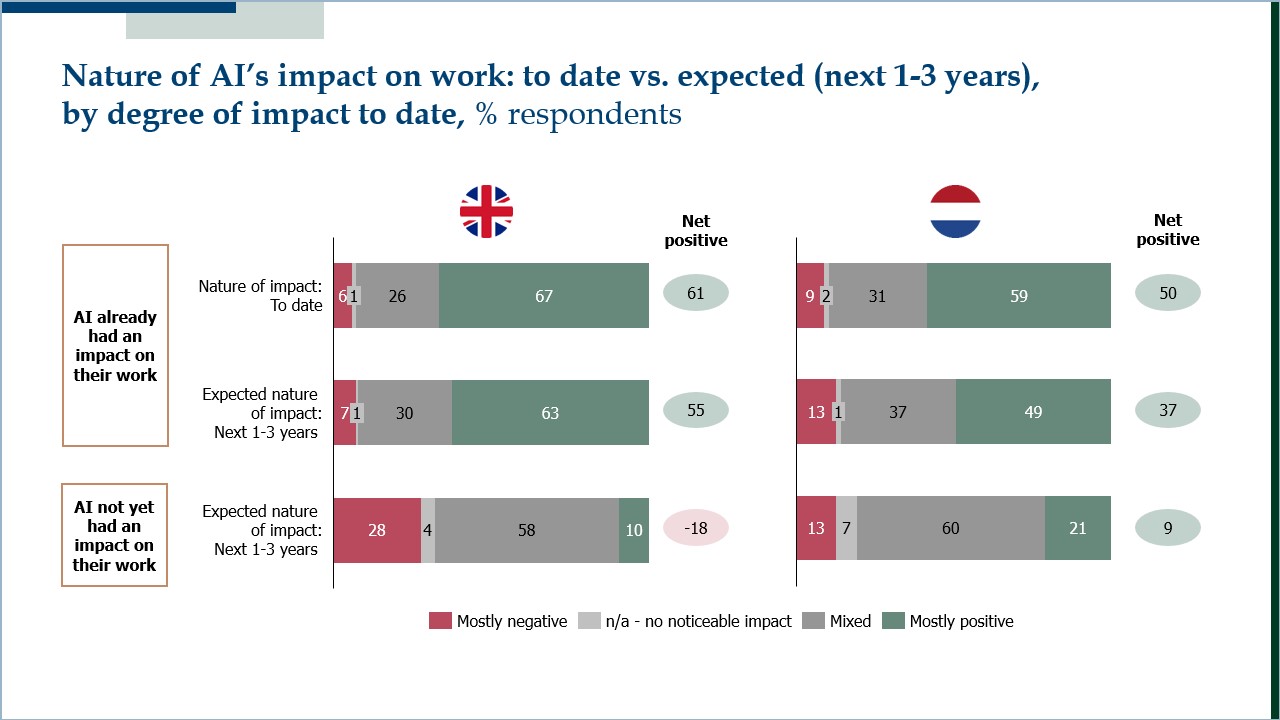
However, workers in both the UK and the Netherlands expect the impact of AI on their work to become less positive and more mixed. While a strong majority report positive impact to date, and future expectations are still net positive, views are more mixed and negative on the future impact of AI.
And those who have not yet seen AI impact their work are much less positive about its future impact, with UK respondents net negative.
Dena McCallum, co-founder of Eden McCallum, notes the relationships between usage, training, confidence, and positivity about AI’s impact. “What is striking in these data is the divide in usage and opinion between younger and older users, managers and non-managers, and those in and outside the workforce,” she says. “There is clearly the potential to do more to support older and more junior employees, and also non-workers, to deliver on AI’s promise. Businesses and our national institutions have an important role to play here.”
Click here to see the full survey results
Follow us on LinkedIn to remain updated