

Eden McCallum Consumer Sentiment and Spend Survey Q3 2026
How are consumers facing up to uncertain and challenging economic times in the second half of 2026? To answer this question Eden McCallum surveyed around 2,000 people in both the UK and the Netherlands to assess their overall sentiment and how they are spending their money.
On balance, there is more hope than gloom among consumers in both countries, but their spending reveals a more watchful mood. The recovery in confidence that had been building since the initial inflation shock from the war in Ukraine has stalled since 2024, and with the cost of essentials rising again, consumers are tightening their belts on discretionary spending.
Testing the mood
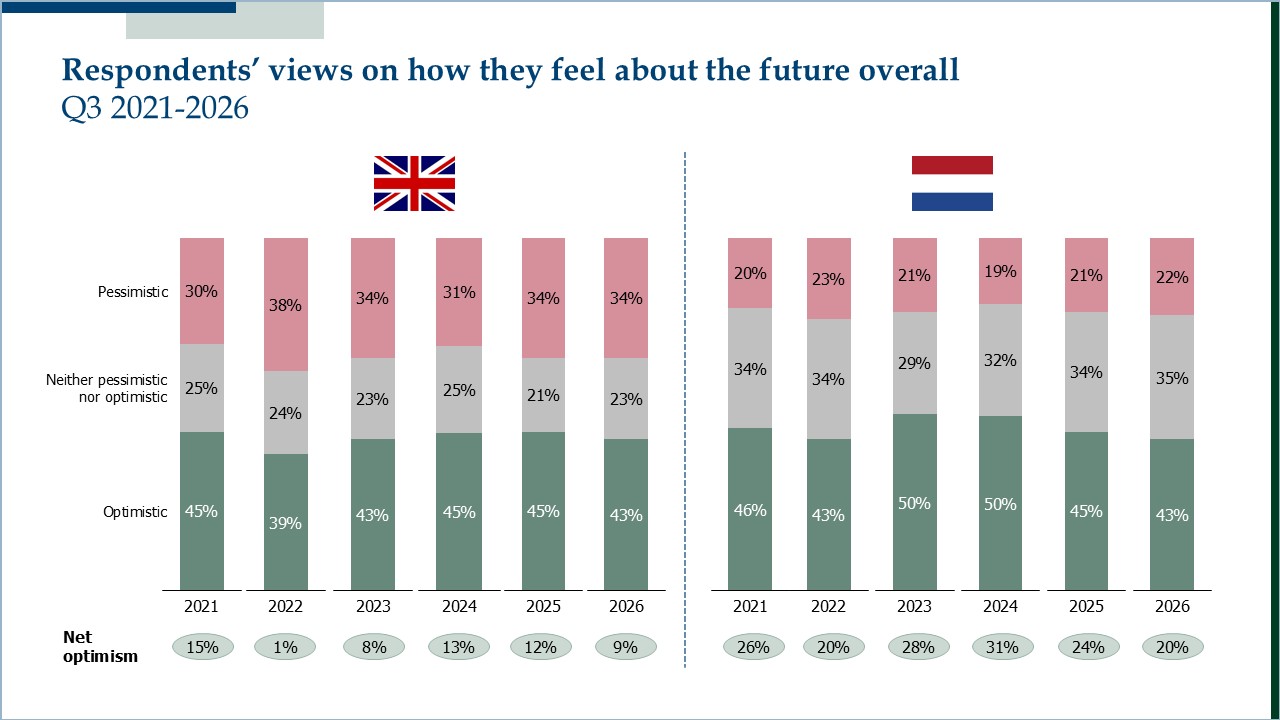
What is the overall mood influencing consumer attitudes? In the UK optimists about the future outnumber the pessimists, but not by an overwhelming margin – 43% are positive while 34% feel more negatively. There is a similar proportion of optimists in the Netherlands but the pessimists are fewer in number – only 22% are gloomy. But net positive scores have been shrinking since 2024 in both countries.
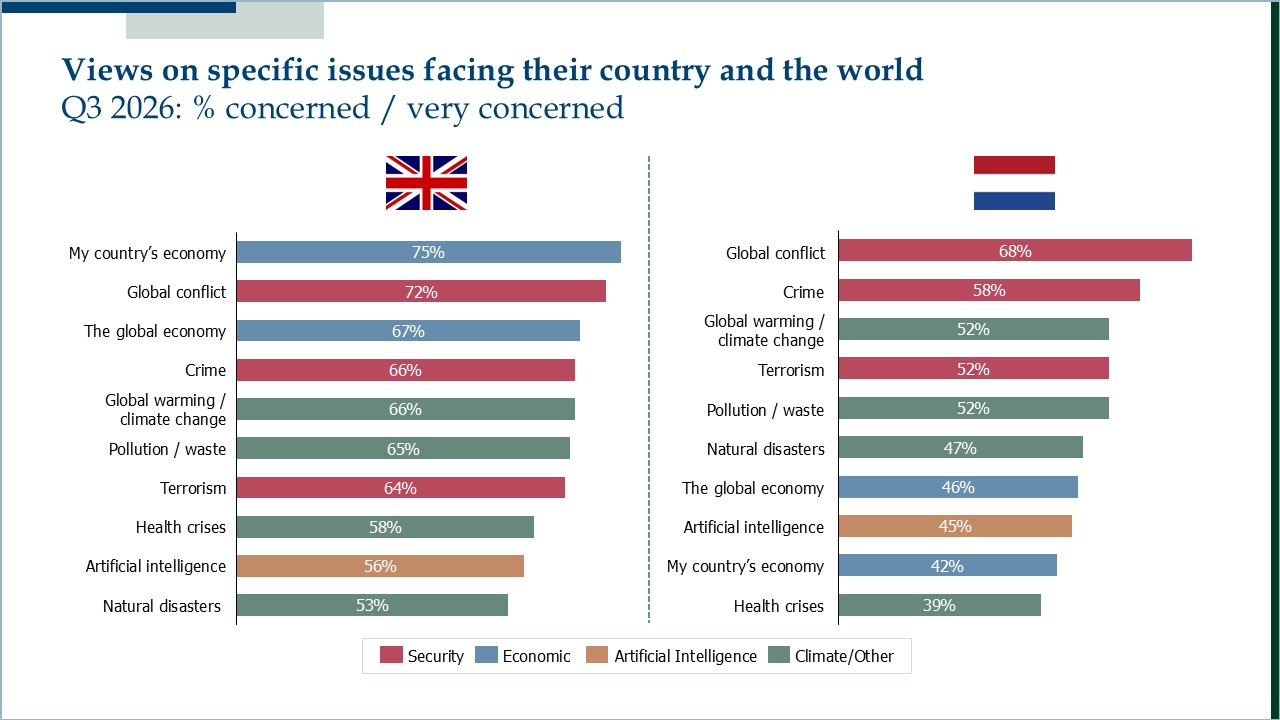
In the UK the domestic economy, global conflict and the state of the world economy are the biggest causes of concern. In the Netherlands global conflict and crime are the biggest worries, followed by climate change and the threat of terrorism. In both countries climate change is of particular concern to the under 35s.
AI was added to our annual survey this year. It is relatively low on the list of concerns in both countries, although it should be noted that there is not a lot of difference between the concern levels across most issues beyond the top one or two. In light of the surge in negative press on the dangers of AI after this survey closed in Q3, key questions were re-run in early October to see if sentiment had changed significantly. While AI rose to become the 5th concern in the Netherlands (from 8th) and the 8th in the UK (from 9th), the absolute changes in concern levels were small – and as memories of the summer’s wildfires began to fade, environmental concerns did as well.
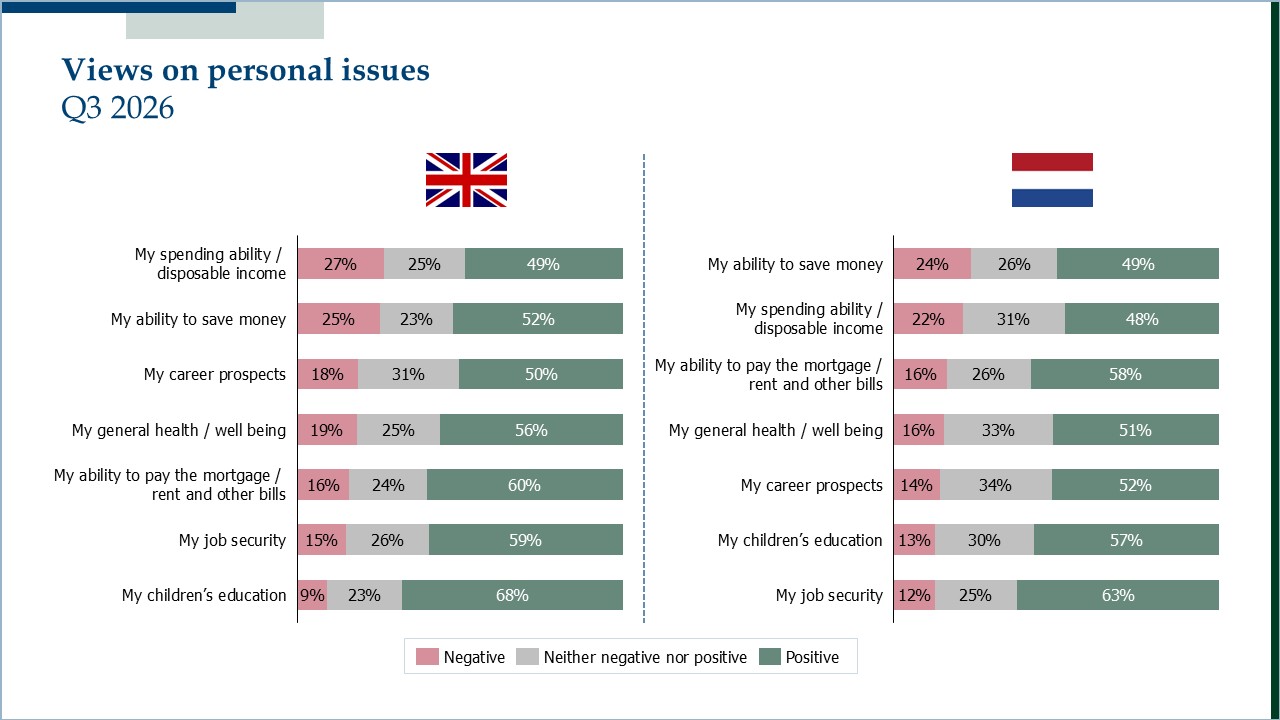
On personal matters, UK respondents remain broadly positive on a range of issues including well-being, job security and their children’s education. However, a quarter of respondents feel negatively about their ability to spend and save. A similar pattern can be seen in the Netherlands of being broadly content across a range of issues; however, 24% worry about saving and 22% about levels of disposable income.
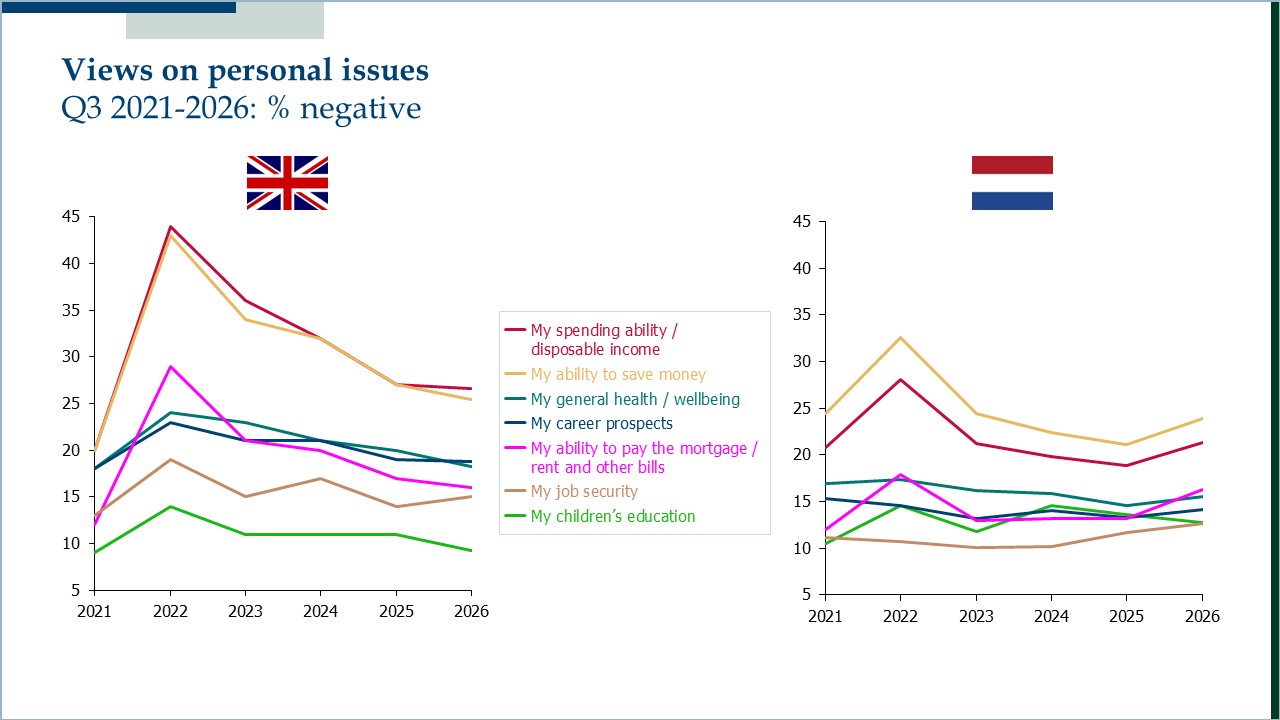
In the UK the recent falls in negative sentiment on spending and saving slowed this year, and negativity on job security increased. In the Netherlands negative sentiment has risen across the board, particularly on consumers’ ability to spend and save and pay their bills.
How does this sentiment impact purchasing decisions? The research finds consumers continuing to carefully manage increased spend on essentials and cutting back on discretionary purchases.
For the purposes of this research spending patterns were grouped under three broad headings: essentials, fashion & home, and entertainment. The essentials category is comprised of groceries (excluding alcohol and tobacco), broadband and mobile. The fashion & home category includes fashion, beauty & personal care, homeware, sports & leisure equipment and child & baby (clothes and toys). The entertainment category is made up of digital entertainment, alcohol & tobacco, entertainment outside the home, restaurants/pubs/bars/cafes, and takeaways.
Key findings on spending patterns
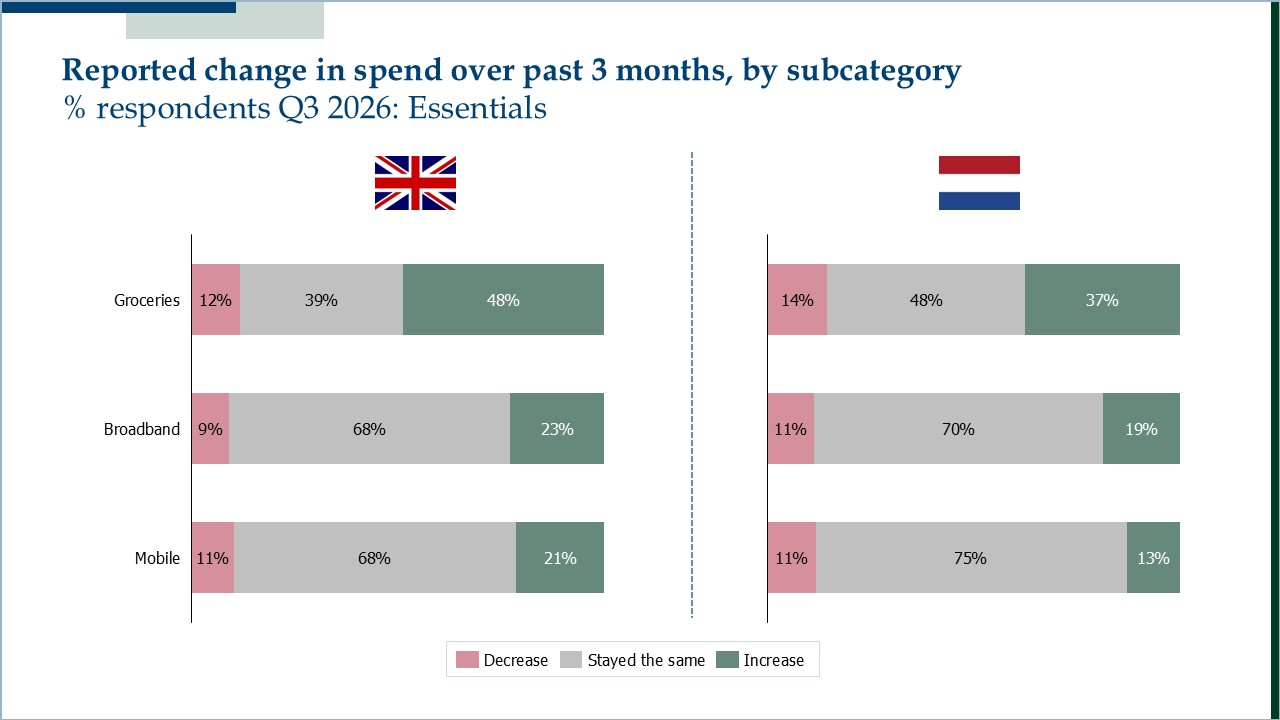
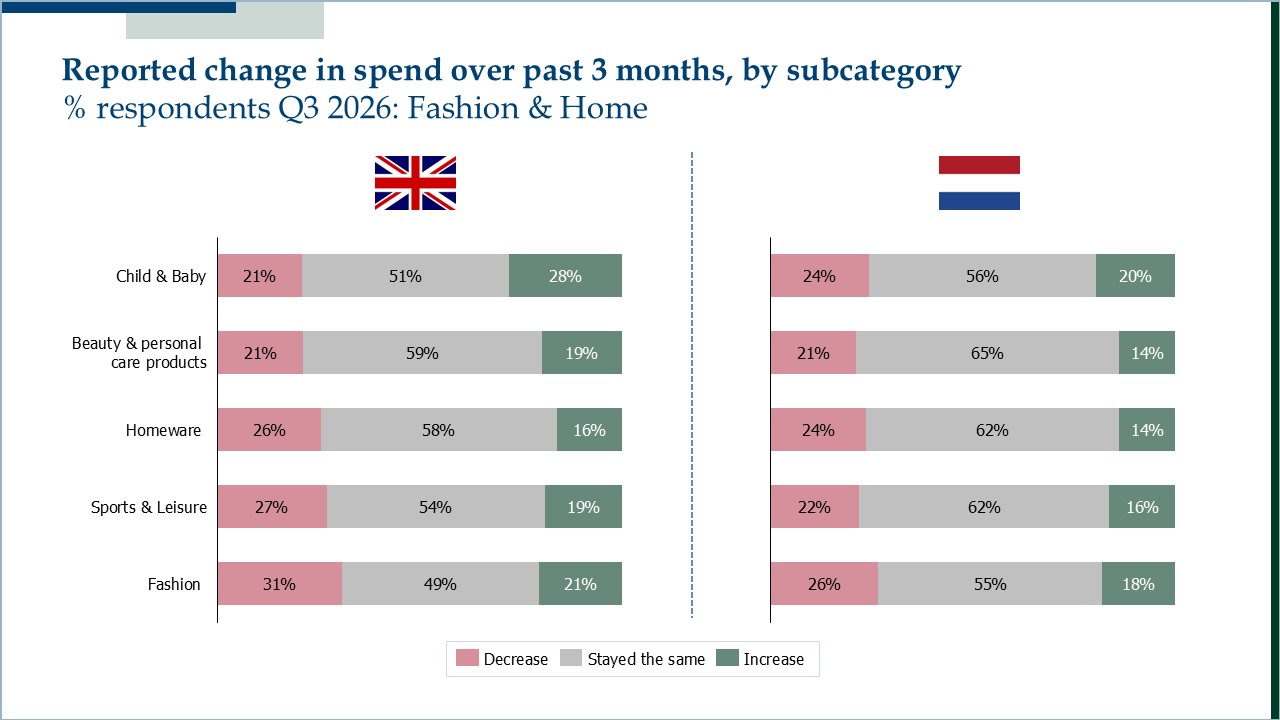
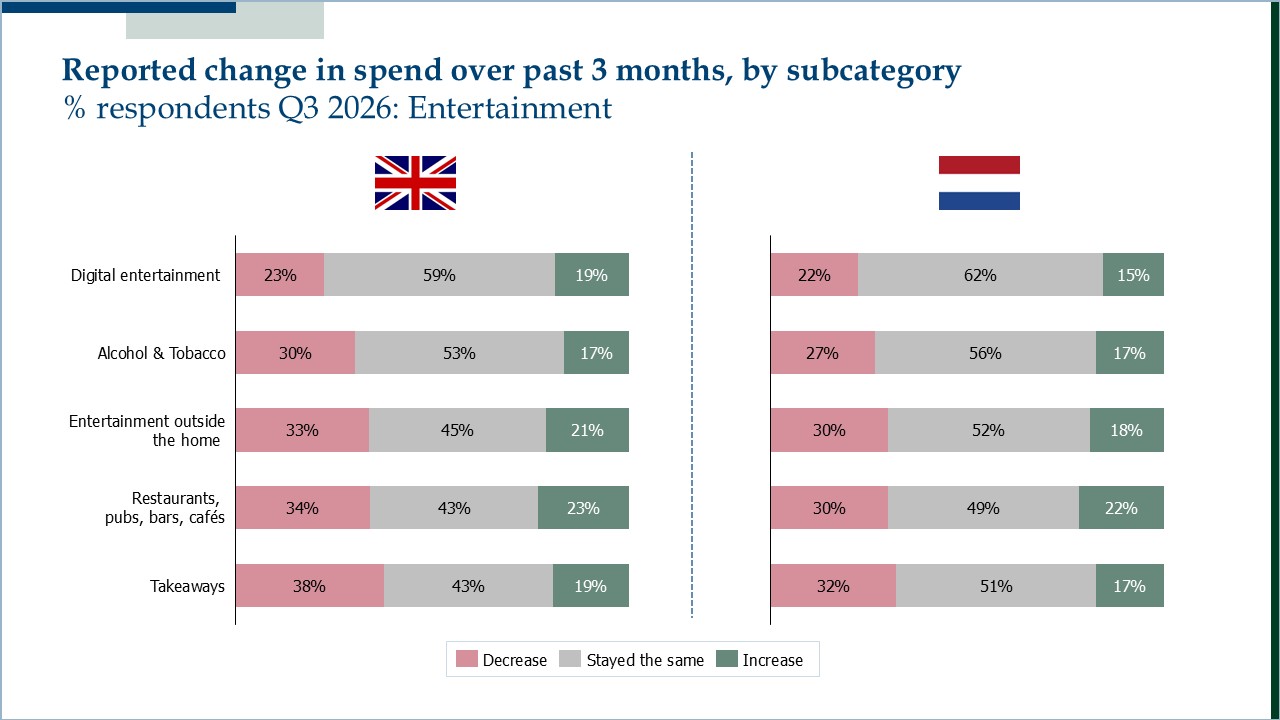
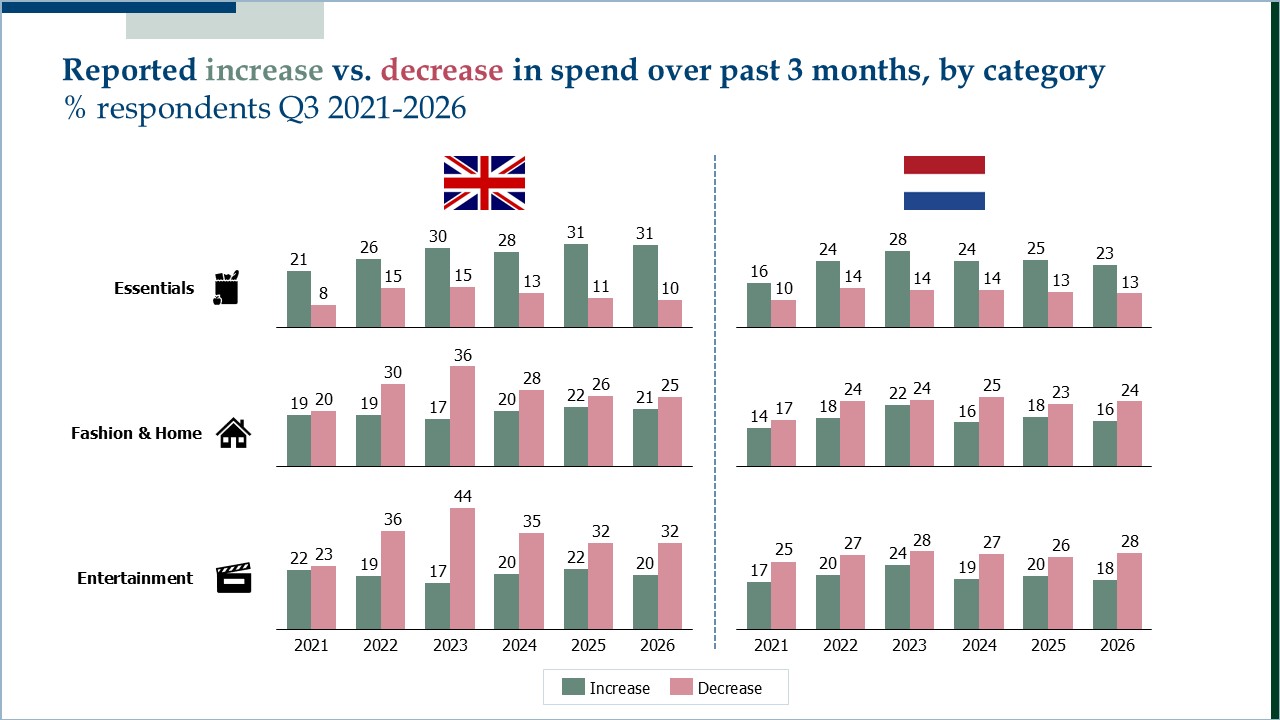
In both the UK and the Netherlands, the proportion increasing their spending over the past three months outnumbered those reducing it in all essentials categories; the opposite was true across most discretionary categories (fashion & home and entertainment).
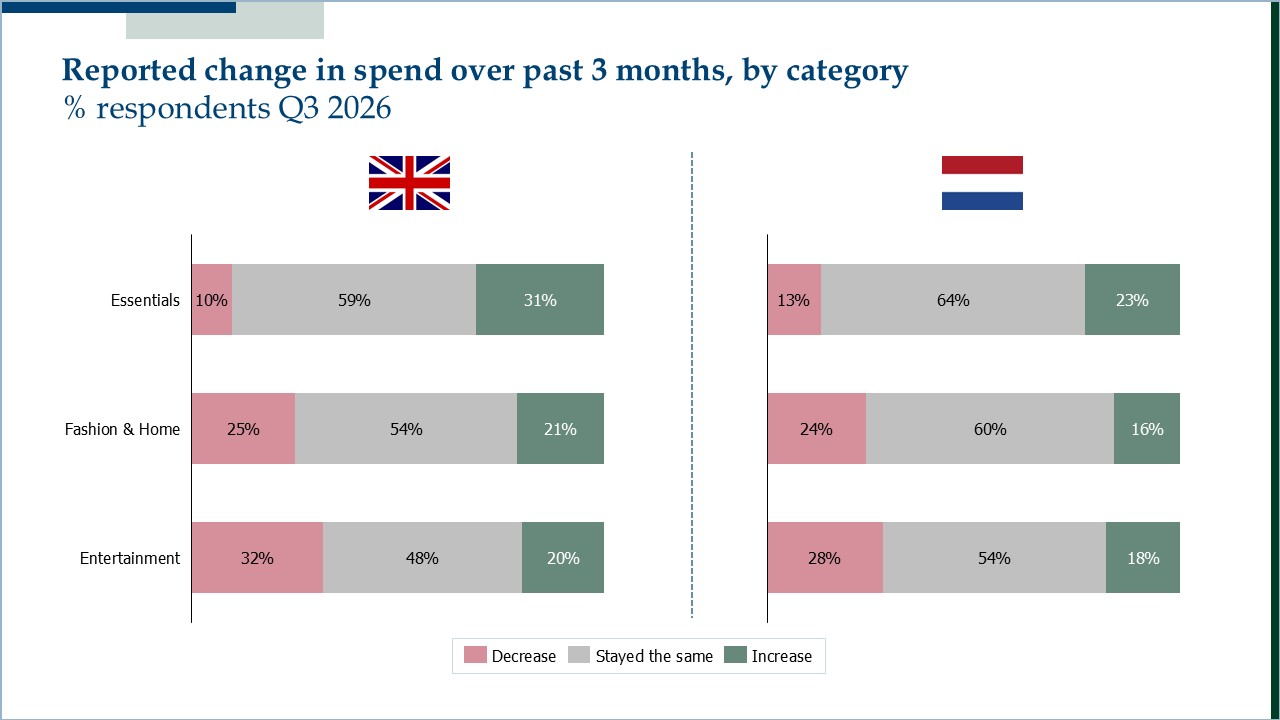
In essentials, the net proportion increasing their spending is by far the greatest in groceries, with the difference significantly more pronounced in the UK, where 48% increased their spending over the past three months.
Looking at the discretionary subcategories in both markets, spend reducers outnumber increasers across the board*. The entertainment subcategories (especially takeaways) are seeing the greatest dominance of spend-reducers.
The cost of living
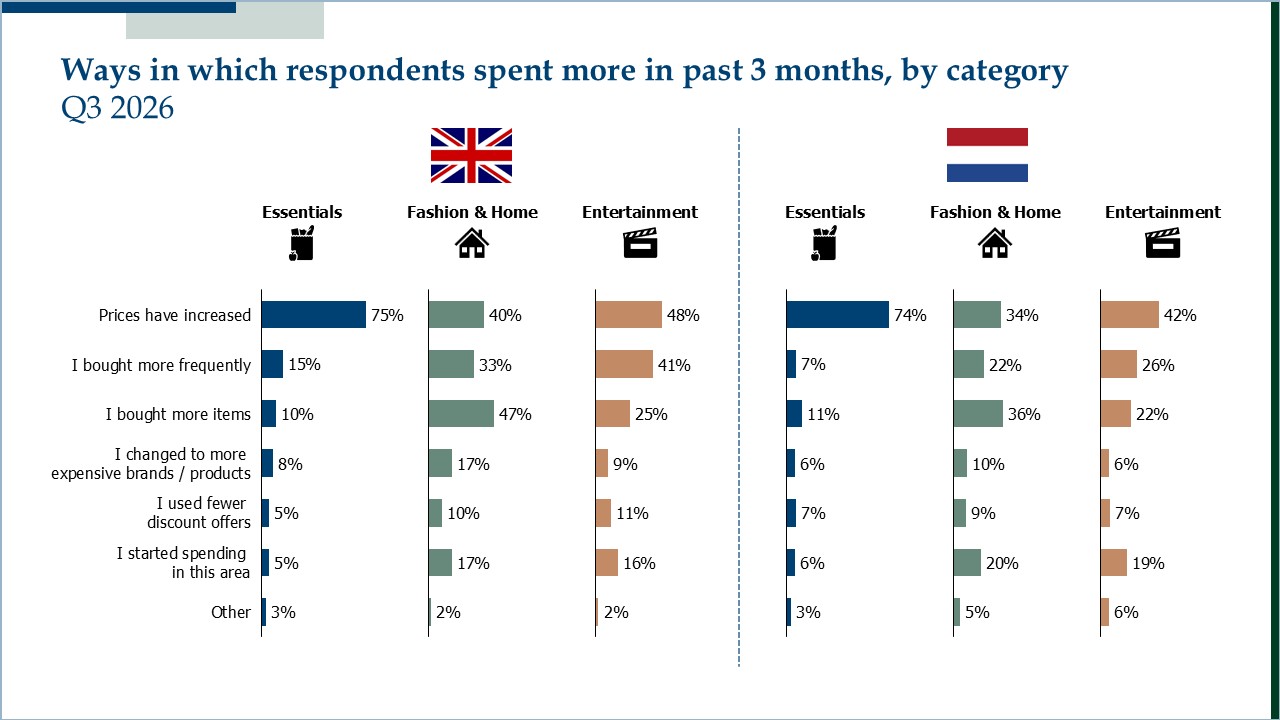
Why are people spending more on essentials? In short: higher prices. Three quarters of those in both countries who said they were spending more said it was because of higher prices. It was the dominant factor across all three subcategories (groceries, broadband, mobile).
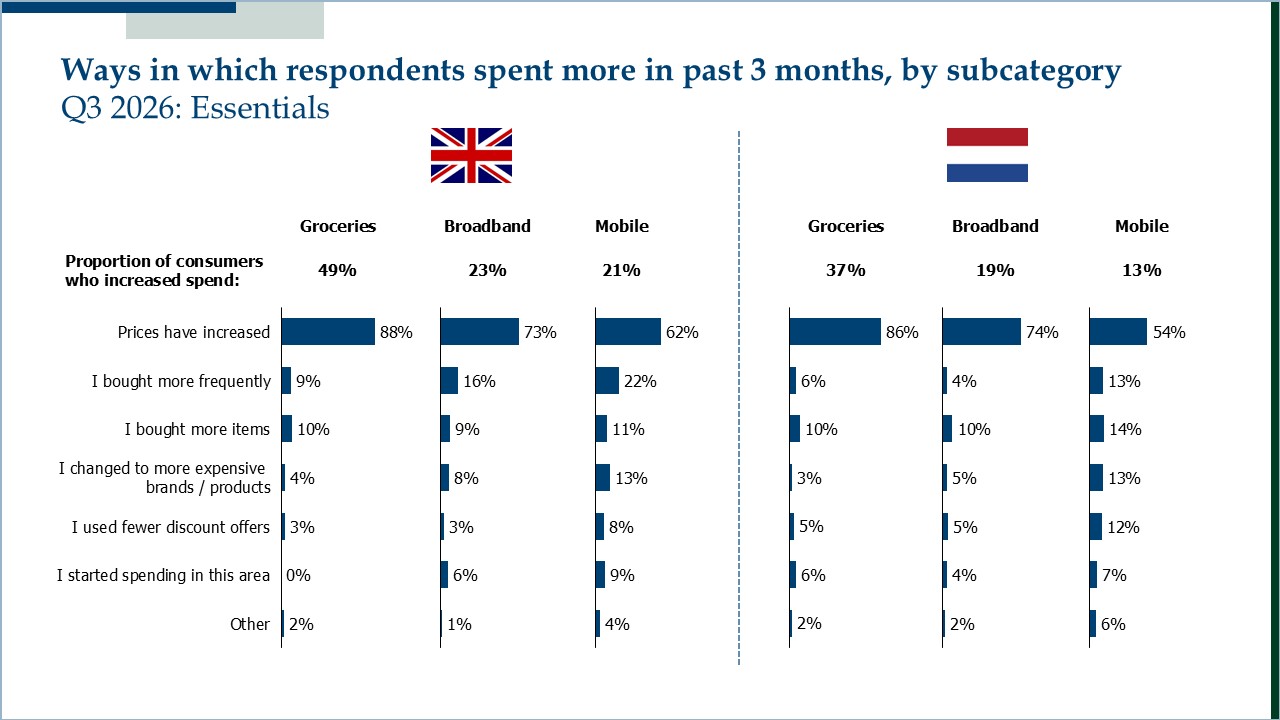
In the fashion & home and entertainment categories in both markets, consumers who were spending more said it was due to price increases (as with essentials), but equally or more prevalent, they were buying more items and buying more frequently. In the UK this was especially the case for fashion and child & baby products. Higher prices were a key factor in the beauty category.
Over time
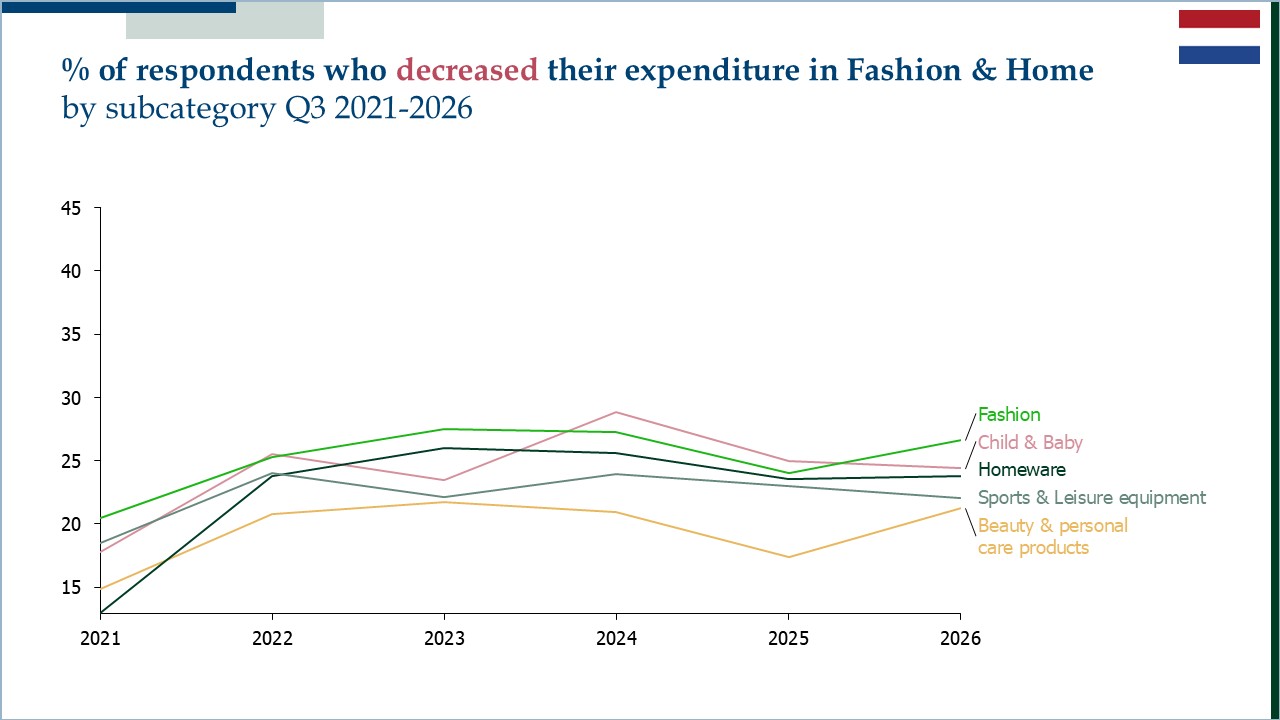
In the discretionary categories, ‘reducers’ have outnumbered ‘increasers’ in spend over the past five years in both markets. However, the situation in the UK seems to be easing (i.e., a reduced number of those decreasing spend and higher number of those increasing spend) while in the Netherlands, the aggregate discretionary spend picture has been largely static over the past four years.
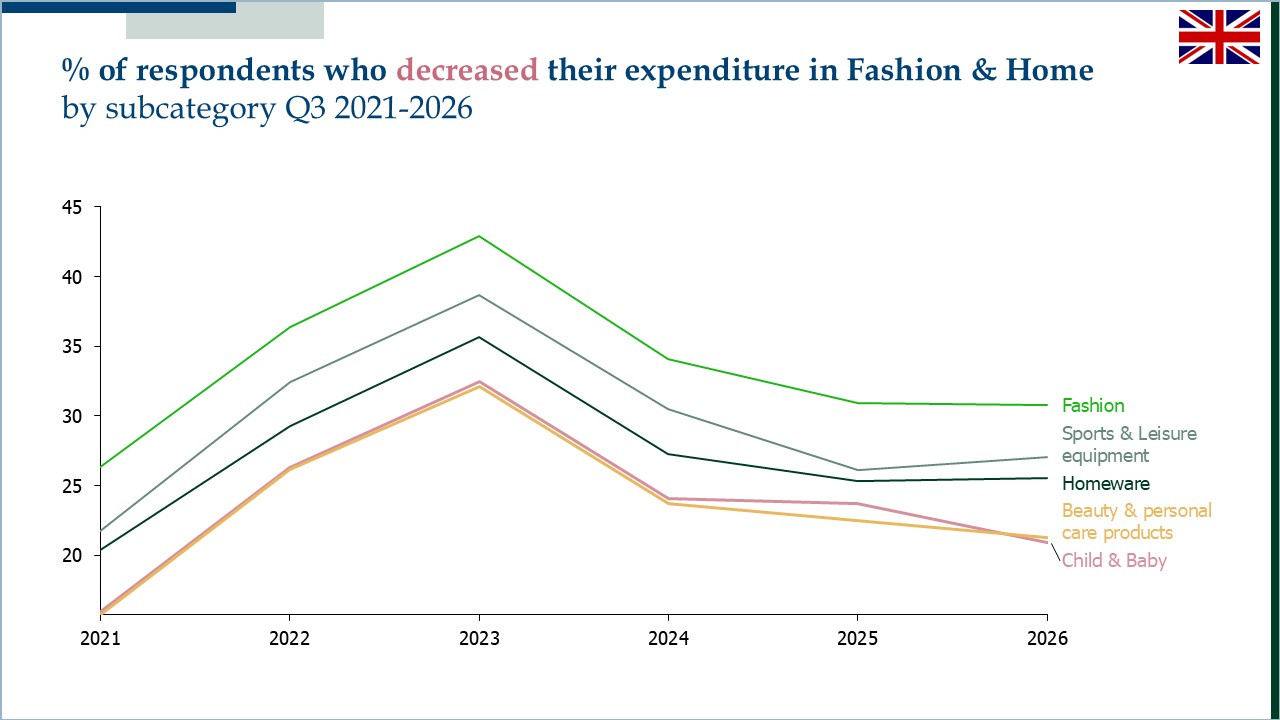
And looking at the subcategories, in the UK the sharp downward trend since 2023 slowed in the past year, with some categories even seeing a small rise in spend-reducers. In the Netherlands, the share of respondents who decreased spending is fairly stable in most subcategories, apart from fashion and beauty, where the numbers decreasing spend are sharply higher.
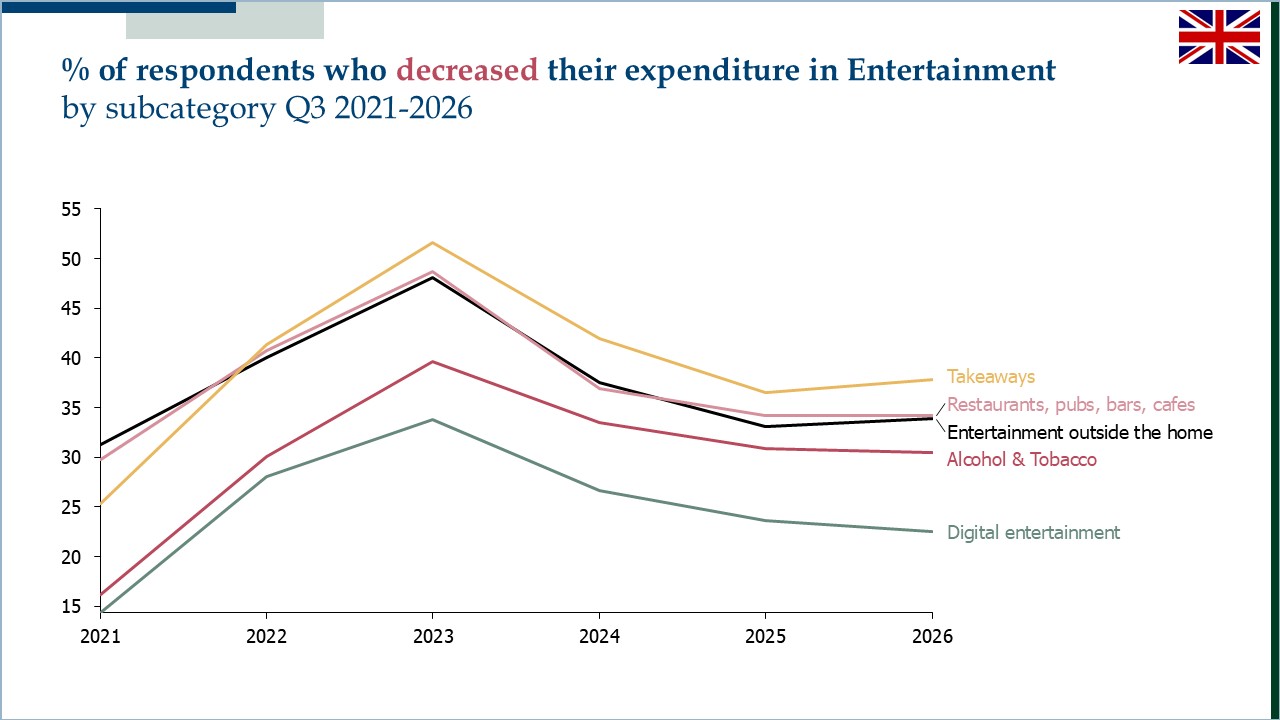
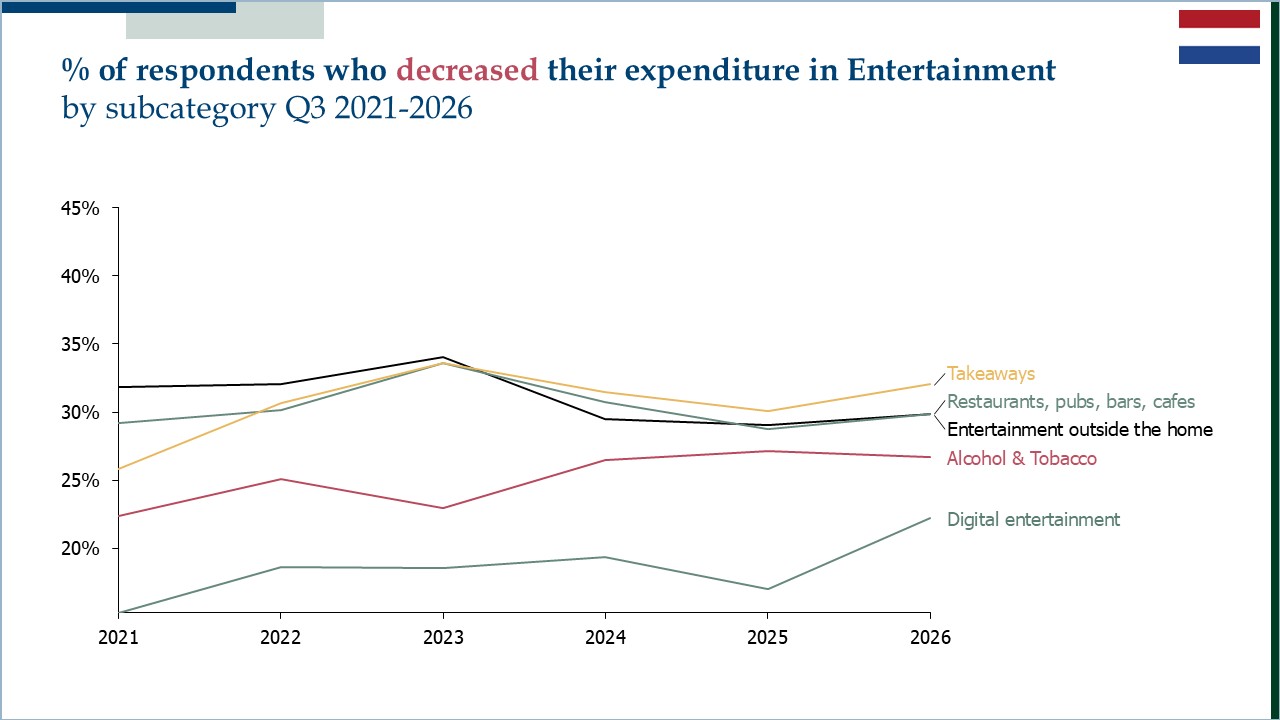
Within entertainment the two markets also differ. In the UK, the proportion reducing their spending on entertainment subcategories was largely flat over the past year, slowing a downward trend since 2023, although takeaways and entertainment outside the home ticked up slightly. In the Netherlands, the proportion of consumers reducing their spending has been largely flat over the past few years, however in many of the subcategories it increased marginally over the past year, and sharply in digital entertainment.
Spending less
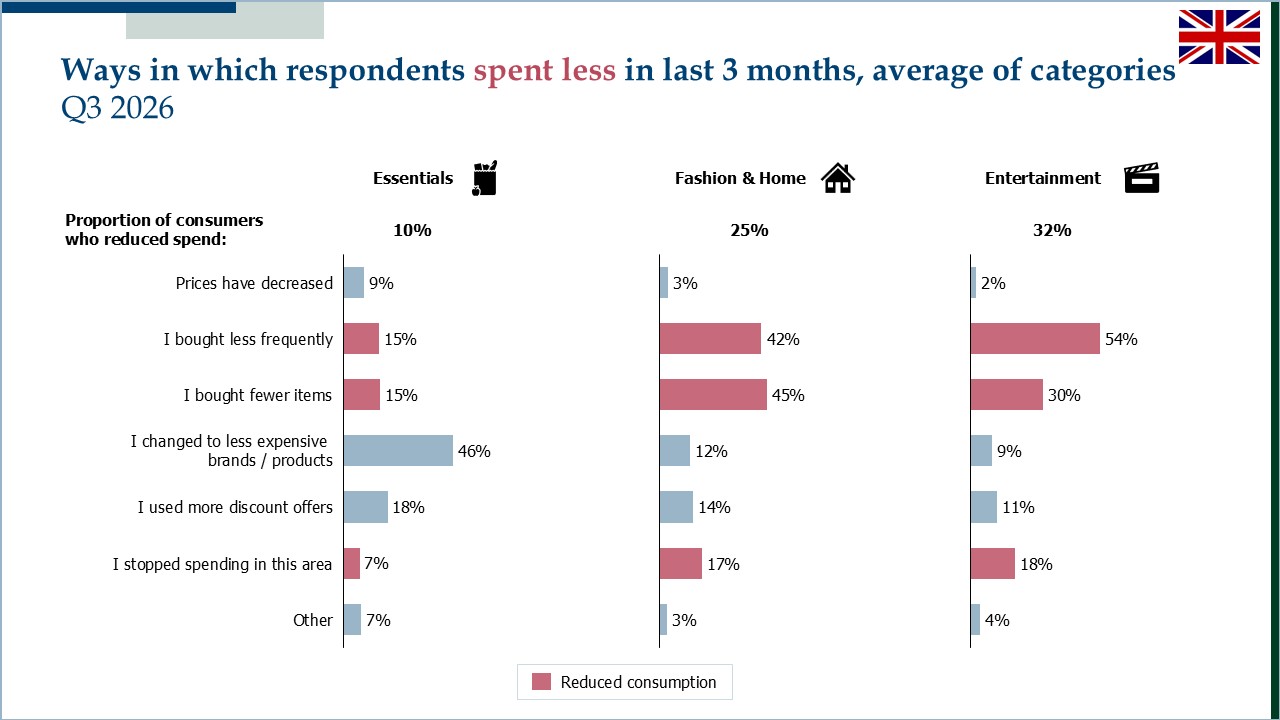
How are consumers reducing their spending? In the UK in the essentials category, decreased spending was achieved by choosing less expensive brands / products and using discount offers.
For discretionary fashion & home and entertainment purchases, reduced consumption was the main route to lower overall spending. Dutch consumers adopted a similar spending pattern to reduce outgoings.
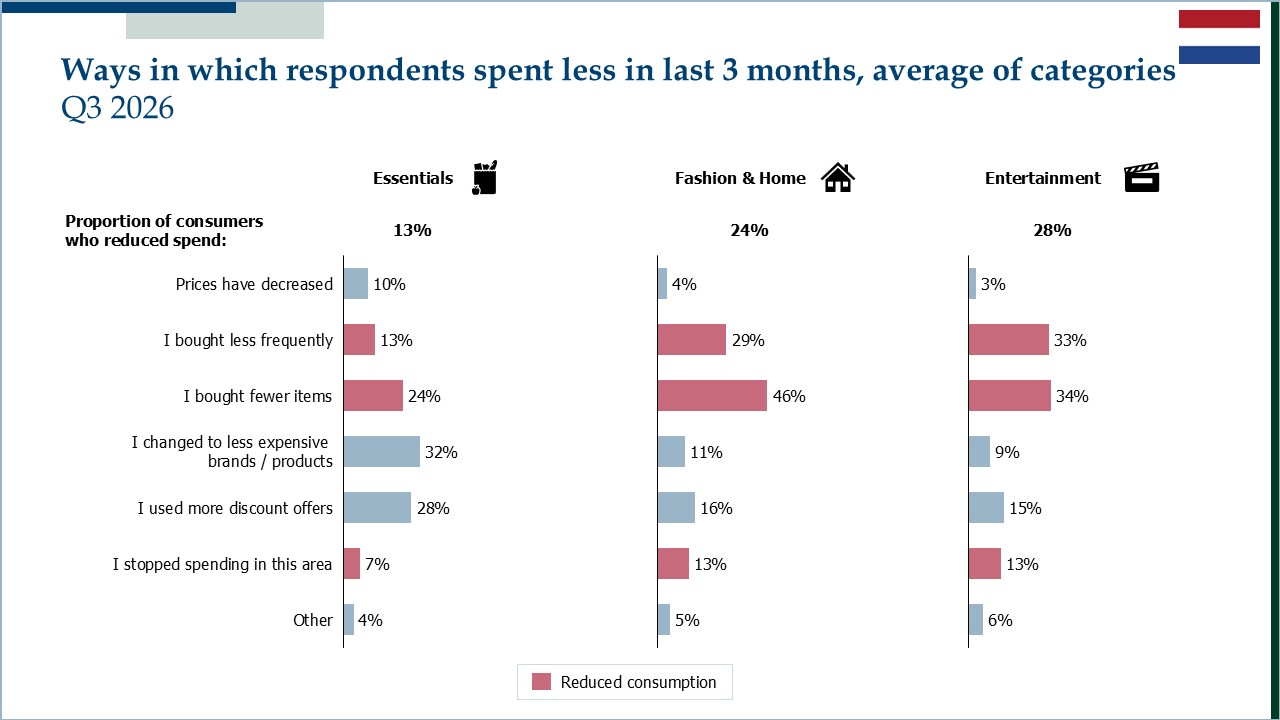
In both countries, decreased spending on groceries was achieved by reducing consumption, choosing cheaper products and using discounts. In the broadband and mobile categories, trading down was the preferred option.
In fashion & home, buying less and/or less frequently were the main ways to reduce spending in both countries. A significant proportion cut spending in some subcategories altogether: in the Netherlands 22% stopped spending on sports & leisure equipment and in the UK, 27% stopped spending on sports & leisure and 20% on homeware.
In the UK spending on entertainment was reduced mainly through buying less often. And here again, some cut items altogether: of those reducing their spending, 28% stopped all spending on digital entertainment and 22% on out-of-home entertainment. In the Netherlands, of those who reduced their spend on takeaways, 49% did so by purchasing fewer.
Dena McCallum, co-founder of Eden McCallum, says that consumers are understandably becoming choosier as they limit their discretionary purchases. “The unavoidable rise in prices, for example of groceries, means that extra care has to be taken by households when it comes to discretionary spending, and this has been true for the past four years. These are tough trading conditions for almost everyone. Value propositions have to be clear and persuasive if businesses are going to grow, as they need to take market share.”
Click here to see the full data for the UK results
Click here to see the full data for the NL results
Follow us on LinkedIn to remain updated
*Except in child and baby (clothes and toys) in the UK